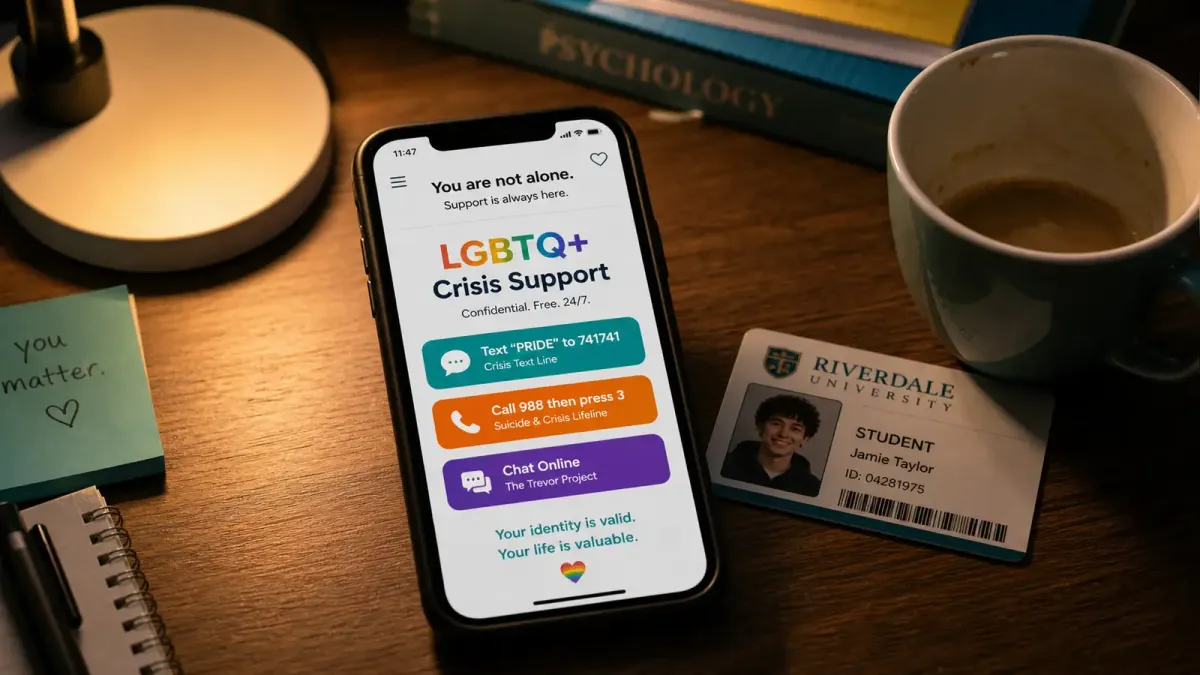
When the Trump administration ended the “Press 3” option on the 988 suicide prevention hotline last summer, it removed a direct line between LGBTQ+ youth and counselors trained to understand their specific experiences. For the 73,000 California callers who used that option between July 2024 and June 2025, the loss was immediate and concrete: a trained voice on the other end of the line was replaced by a generic one.
California is now trying to make sure that never happens again. Governor Newsom signed two bills into law this month that permanently fund LGBTQ+-competent crisis counseling and put Trevor Project hotline numbers on student identification cards across the state. The legislation arrives at a moment when federal data on LGBTQ+ bullying is being stripped from the surveys that track it, leaving advocates uncertain about what the national picture actually looks like.
What California’s new laws actually do
Assembly Bill 2003, carried by Assemblymember Berman, makes permanent a training program that began as an emergency response to the federal rollback. The state allocated funds to train counselors handling California-based 988 calls on queer and transgender issues, with oversight from The Trevor Project. The program had been operating on temporary appropriations; the new law gives it a permanent funding stream through the 988 State Suicide and Behavioral Health Crises Services Fund.
The cost is not trivial. The state’s Office of Emergency Services estimated it would initially cost upward of $1 million for the telecommunications infrastructure needed to route calls to trained counselors, plus $791,000 annually to support three permanent positions. For a state with one of the largest LGBTQ+ populations in the country, advocates argue the math is straightforward: the alternative is a crisis line that cannot serve the people most likely to need it.
Assembly Bill 727, carried by gay Assemblymember Mark González of Los Angeles, took effect July 1 and requires that The Trevor Project’s 24/7 suicide hotline number (1-866-488-7386) appear on student identification cards for grades 7 through 12, as well as at the state’s public colleges and universities. The line can also be reached by texting START to 678-678.
González framed the bill in blunt terms. “LGBTQ+ youth face a 3x rate of attempting suicide than their peers,” he wrote in an Instagram post marking the law’s implementation. “This law places a lifeline in their hands.”
The physical presence of a crisis number on an ID card might seem like a small thing. But for a 14-year-old who is not ready to tell a parent or teacher that they are struggling, a number printed on something they already carry can be the difference between getting help and suffering in silence. The card sits in a wallet or a backpack, visible only to the person who needs it, requiring no disclosure and no explanation. In a state where nearly a third of LGBTQ+ youth report not feeling safe at school, that kind of discreet access to help is not a luxury. It is a necessity.
The federal data gap is growing
While California builds infrastructure, the federal government is dismantling the data systems that track the problem. The Human Rights Campaign condemned the Department of Education’s decision to remove LGBTQ+ bullying data from a federal survey, calling it a direct attack on the ability to understand and address the crisis.
The Trevor Project’s own data tells a grim story that makes the federal removal feel particularly reckless. For the seventh consecutive year, LGBTQ+ youth remain at elevated suicide risk due to mistreatment and stigmatization. Nearly 60 percent of LGBTQ young people ages 13 to 17 reported being bullied in the past year. Thirty-six percent seriously considered suicide. For trans youth, that number climbed to roughly 40 percent.
These are not abstract statistics. They represent kids sitting in school bathrooms wondering if anyone would notice if they did not come back. They represent teenagers lying awake at night calculating whether the pain of coming out is worse than the pain of hiding. They represent the students who are supposed to be learning algebra and writing essays but are instead spending their energy just trying to survive the day.
Removing the data that tracks bullying does not remove the bullying. It removes the ability to prove it is happening, to allocate resources to the schools where it is worst, and to hold administrators accountable when they fail to protect vulnerable students. Without data, the conversation becomes anecdotal, and anecdotal conversations are easy to dismiss.
The federal government’s action also undermines the work of researchers who rely on consistent, longitudinal data to study trends in youth mental health. When a data point disappears from a survey, it does not just vanish from a spreadsheet. It creates a gap in the historical record that cannot be retroactively filled. Advocates who spent years pushing for the inclusion of LGBTQ+ questions in federal surveys now face the possibility that the next generation of data will simply not exist.
School districts that used federal survey data to justify funding for anti-bullying programs and counseling services are left scrambling. Without the numbers, administrators can claim the problem is smaller than it actually is, or that their district is an exception. Data accountability is one of the few tools that forces institutional action, and the Department of Education has just removed it.
What campus mental health actually looks like right now
The gap between what LGBTQ+ students need and what they actually get remains wide. College counseling centers across the country report record demand, with wait times stretching weeks for students in crisis. For LGBTQ+ students, the problem is compounded by a shortage of counselors with specific training in queer and trans mental health.
Students at schools without robust support systems often end up navigating a patchwork of resources on their own. They might find a counselor through an off-campus referral, connect with a peer support group that meets monthly in a borrowed classroom, or rely on a single faculty advisor who happens to be an ally. The patchwork holds for some students. For others, it falls apart at the worst possible moment.
The situation is not uniform across the country. States with strong anti-discrimination protections and dedicated funding for LGBTQ+ youth services tend to have more robust support systems. States that have passed laws restricting discussion of sexual orientation and gender identity in schools create environments where LGBTQ+ students are less likely to seek help, even when it is available. The psychology is simple: if your existence is treated as controversial, asking for help feels like an act of exposure.
California’s AB 727 addresses part of this problem by normalizing the presence of crisis resources in educational settings. When a hotline number is on every student ID, it signals that mental health support is a standard part of the educational experience, not a special accommodation for a specific group. That normalization matters more than it might appear on the surface.
For college students specifically, the requirement extends to public universities and community colleges. This is significant because community colleges serve a disproportionate share of LGBTQ+ students who are first-generation college students or come from unsupportive family environments. These students are less likely to have access to private mental health resources and more likely to rely on campus-provided services. Having a crisis number on their student ID removes a barrier that most administrators do not even realize exists.
The numbers that should alarm everyone
The Trevor Project estimates that LGBTQ+ youth are more than four times as likely to attempt suicide compared to their peers. The statistic has been cited so many times that it risks becoming background noise. But consider what it means in practice: in a classroom of 30 students, if four or five are LGBTQ+, statistically at least one of them will attempt suicide before they graduate.
The 988 hotline handled over 5 million contacts in its first full year of operation nationally. The Press 3 option for LGBTQ+ callers was used tens of thousands of times across the country, with California alone accounting for 73,000 calls in a single year. These were not casual inquiries. People do not call a suicide prevention line out of curiosity.
Assembly Bill 1540, which Newsom also signed, requires the state to develop a plan for integrating the LGBTQ+-trained 988 counselors into the broader crisis response system. The bill directs the Office of Emergency Services to report back on how many calls are routed to LGBTQ+-competent counselors, wait times, and outcomes. That data will be public, creating a level of transparency that does not exist at the federal level.
The reporting requirement is significant because it creates accountability. When the public can see how many LGBTQ+ callers are served, how long they wait, and what happens after the call, it becomes harder for future administrations to quietly defund the program. Transparency is a form of protection.
Where this leaves students outside California
The California model is being watched closely by advocates in other states. If the permanent funding and student ID requirements prove effective, they could become a template for legislation elsewhere. But the political reality is that many states are moving in the opposite direction, introducing bills that restrict access to gender-affirming care, limit what teachers can say about sexual orientation and gender identity, and make it harder for LGBTQ+ students to access support services.
For students in those states, the 988 hotline remains a critical resource, but its reliability depends on federal funding that has already been targeted for cuts. The Trevor Project continues to operate its own crisis line independently, but it cannot replace a federally funded system that was designed to reach every caller in the country.
The contrast between California’s response and the federal government’s actions could not be sharper. One is building permanent infrastructure to protect its most vulnerable young people. The other is removing the data that would show they need protecting in the first place. For LGBTQ+ students watching from states without California’s protections, the message is mixed: help exists, but it depends on where you live, who you are, and whether the systems around you are willing to acknowledge that you exist.
If you or someone you know is struggling, the Trevor Project crisis line is available 24/7 at 1-866-488-7386 or by texting START to 678-678.