Free speech on campus has always been complicated. Add LGBTQ+ identity into the mix, and the layers of legal protections, institutional policies, and social dynamics become genuinely hard to navigate. If you are an LGBTQ+ student trying to figure out what you can say, where you can say it, and what happens when someone pushes back, this guide breaks down the current landscape as of 2026.
The legal foundation has shifted — know where you stand
The First Amendment protects speech from government restriction, which means public universities must honor it. Private universities are not bound by the First Amendment, but most have their own free speech policies written into student handbooks or mission statements. The distinction matters because your rights depend heavily on where you go to school.
At public institutions, the Supreme Court has consistently held that student speech is protected unless it creates a genuine disruption to the educational environment. The Tinker standard from 1969 — “it can be suppressed only if it materially and substantially interferes with the operation of the school” — still applies, though recent cases have tested its boundaries.
The practical implication is straightforward: at a public university, you can wear a pride flag, hand out flyers about an LGBTQ+ event, organize a vigil, or publicly criticize your administration’s policies on transgender student housing. The administration cannot stop you because it disagrees with your message. They can ask you to move your table to a designated tabling area, or require you to reserve a room for a large event, but they cannot shut you down because your speech makes them uncomfortable.
At private universities, the picture is murkier. Some institutions, particularly those with religious affiliations, have policies that restrict expression about sexual orientation or gender identity. Others, like many liberal arts colleges, have adopted free speech statements modeled on the University of Chicago’s Kalven Report, which commits the institution to institutional neutrality on political questions while protecting individual student expression. Before you assume your rights are protected, read the actual policy documents.
In 2024, the Supreme Court ruled in Moody v. NetChoice that states cannot compel social media platforms to host speech they would otherwise remove. While this case did not directly address campus speech, legal scholars have noted that its reasoning about the government’s limited power to regulate expression could have downstream effects on how public universities handle student speech policies. The decision reinforced that the government, including public universities, faces a high bar when restricting speech based on its content.
For LGBTQ+ students specifically, the intersection of free speech and anti-discrimination law creates a unique situation. You have the right to express your identity, advocate for your community, and challenge policies you believe are discriminatory. At the same time, institutions have a legal obligation to prevent harassment, which means speech that targets individual students based on their sexual orientation or gender identity can cross the line from protected expression into actionable harassment.
Understanding where that line falls requires a basic distinction: speech about ideas is generally protected; speech targeting a specific person with the intent to harm is not. Criticizing a university’s decision to restrict gender-neutral bathrooms is protected speech. Following a transgender student around campus and repeatedly calling them by their deadname is harassment. The difference lies in whether the speech is directed at a policy or institution versus directed at an individual with the purpose of causing harm.
Anti-discrimination policies are your strongest tool — if they exist
Title IX prohibits sex-based discrimination in federally funded education programs. Since the Bostock v. Clayton County decision in 2020, the Supreme Court has held that sex discrimination includes discrimination based on sexual orientation and gender identity. This means that at any institution receiving federal funding — which is virtually every college and university in the United States — discrimination against LGBTQ+ students is illegal under federal law.
However, enforcement has varied significantly across administrations. The current regulatory landscape as of 2026 reflects ongoing legal challenges and shifting interpretations. Some institutions have strengthened their anti-discrimination protections in response to uncertainty at the federal level, while others have adopted more cautious approaches.
What this means for you in practice: check your institution’s non-discrimination policy. Most universities publish these in their student handbooks and on their website. Look for explicit mentions of sexual orientation and gender identity. If your institution’s policy does not include these protections, that is a gap worth raising with your student government, Title IX coordinator, or campus advocacy organizations.
The Human Rights Campaign’s Municipal Equality Index and the Campus Pride Index both rate institutions on their LGBTQ+ inclusion policies. These ratings can help you understand how your school compares and where there is room for improvement.
Protest and demonstration rights on campus
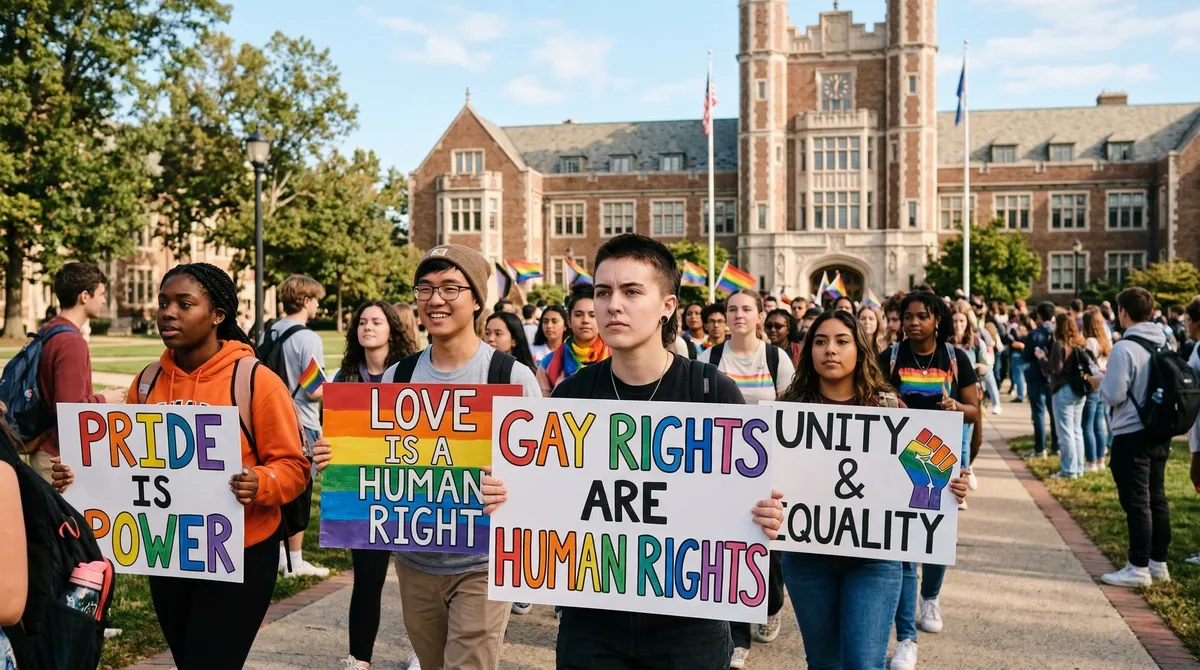
Public universities generally cannot prohibit student protests based on the content of the message being expressed. You have the right to hold signs, distribute leaflets, organize rallies, and engage in other forms of peaceful protest on campus, including speech that advocates for LGBTQ+ rights or criticizes institutional policies.
That said, institutions can impose reasonable time, place, and manner restrictions. These restrictions must be content-neutral, meaning they apply equally to all speech regardless of its message. A university can require advance notice for large gatherings, designate specific areas for protests, or set noise limits — but it cannot use these rules to selectively silence LGBTQ+ advocacy.
Here is what this looks like in practice. If your university requires all student organizations to reserve space 48 hours in advance for events with more than 50 people, that rule applies equally to an LGBTQ+ pride rally and a conservative speaker’s lecture. If the university waives the rule for one group but enforces it for another, that is a potential free speech violation worth reporting.
If campus police or security attempt to break up a peaceful demonstration, stay calm and document the interaction. Record video if you can do so safely. Ask for the specific policy or rule they claim you are violating. You are not required to stop protesting simply because an officer tells you to — but you should be aware of the distinction between protected protest and activities that might technically violate a content-neutral rule, like blocking a walkway or refusing to leave a building after hours.
Private institutions have more discretion. Their policies may restrict protests, demonstrations, or speech in ways that public universities cannot. If you attend a private school, review your student handbook carefully. Some private universities have robust free speech protections written into their charters; others give administrators broad authority to regulate campus expression.
Recent years have seen an increase in campus protest activity across the political spectrum. In response, some states have passed laws imposing penalties on protesters or restricting demonstration activities on college campuses. These laws vary widely in scope and enforceability, and many face ongoing legal challenges. If you plan to participate in campus protests, it is worth consulting with your campus LGBTQ+ center or a legal aid organization to understand the specific rules in your state.
Digital speech and social media policies
Your free speech rights extend to online spaces, but the rules get murkier when you are posting on university-owned platforms or using your institutional email. Most universities do not regulate student social media accounts, but some have policies about using institutional email or university-branded accounts for political advocacy.
The practical reality is that digital speech carries risks that campus speech sometimes does not. A post that would be protected expression on campus can still result in social consequences, employer scrutiny, or targeted harassment online. This is especially true for LGBTQ+ students, who face higher rates of online harassment than their peers.
If you encounter online harassment targeting your identity, most universities have reporting mechanisms through their student conduct offices or Title IX coordinators. Document everything — screenshots, URLs, timestamps — before reporting. Many institutions also offer digital safety resources through their counseling centers or LGBTQ+ offices.
There is also the question of anonymous speech. Students sometimes create anonymous social media accounts to discuss campus issues, including LGBTQ+ policies, without risking personal consequences. Public universities generally cannot compel you to reveal your identity for the purpose of punishing protected speech, but private universities may have different rules. If you plan to speak anonymously, understand both the legal protections and the practical risks.
One more thing about digital spaces: group chats, Discord servers, and private social media groups are not public forums in the legal sense. The First Amendment does not protect speech on private platforms, which means a university generally cannot be held responsible for failing to prevent harassment that occurs in a student-run group chat. However, if a university employee participates in or facilitates such harassment, that changes the equation significantly.
When your rights are violated: what to do
If you believe your free speech rights have been violated on campus, there are several steps you can take. Start with your institution’s internal processes. Most universities have an ombudsperson, a student affairs office, or a grievance procedure that handles complaints about institutional policy violations.
Before you file a complaint, gather your documentation. Write down exactly what happened, including dates, times, locations, and the names of any witnesses. Save any emails, text messages, or other communications related to the incident. If there is a recording of the event, preserve it. The more specific and organized your documentation, the stronger your complaint will be.
For public universities, you can also file a complaint with the Department of Education’s Office for Civil Rights. The office investigates complaints of discrimination based on sex, which includes sexual orientation and gender identity under current interpretation. Complaints must generally be filed within 180 days of the alleged discrimination, so do not delay if you believe your rights have been violated.
Organizations like the American Civil Liberties Union, Lambda Legal, and the National Center for Lesbian Rights provide legal guidance and sometimes representation for cases involving LGBTQ+ rights and free speech on campus. If your situation involves a potential legal violation, reaching out to one of these organizations can help you understand your options.
Campus LGBTQ+ centers and student organizations are also valuable resources. They often have experience navigating institutional processes and can connect you with peers who have faced similar situations. You do not have to figure this out alone.
There is a common fear that filing a complaint will make things worse. Sometimes it does create friction in the short term. But institutions that know their students are paying attention and willing to use formal processes are institutions that tend to fix problems faster. Silence tells the administration that the status quo is acceptable. A formal complaint tells them it is not.
Building a culture that protects speech and safety
The hardest part of free speech on campus is balancing expression with safety. LGBTQ+ students have the right to speak their truth, advocate for their community, and challenge policies they believe are harmful. At the same time, no one should have to endure harassment or threats because of who they are.
The institutions that get this right are the ones that create clear policies, enforce them consistently, and invest in education. They teach students that free speech and respect are not opposing values — they are complementary ones. A campus where everyone feels safe to speak is a campus where meaningful dialogue actually happens.
As a student, you can help build that culture. Speak up for your own rights and for the rights of others. Support policies that protect expression while preventing harm. Hold your institution accountable when it falls short. And remember that the work of making campus a better place for LGBTQ+ students is ongoing — it does not happen in a single protest or a single policy change, but in the daily practice of showing up and insisting on better.