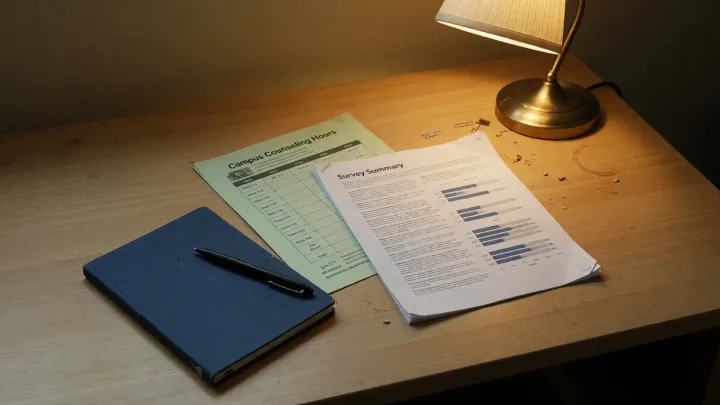
A student who needs help at 2 a.m. has few options. The counseling center opens at nine, the waitlist runs into weeks, and the crisis line means talking to a stranger. For a growing share of LGBTQ+ young people, the first stop is something else entirely: a chatbot. New data from The Trevor Project, published November 18, puts a number on that habit. Forty percent of LGBTQ+ young people in its longitudinal study had used an AI chatbot for mental health support, and nearly three quarters of those users said the experience was at least somewhat helpful.
That number deserves a careful read. A chatbot is not a counselor, and the same research brief says so in plain terms. The finding still matters for campuses, because it describes what students actually do when professional support is slow, hard to reach, or hard to trust. The students turning to chatbots are often the ones counseling centers struggle hardest to reach.
What the Trevor Project found
The Trevor Project’s research brief, AI Chatbot Use for Mental Health Support Among LGBTQ+ Young People, draws on two datasets. The first is the organization’s 2025 U.S. National Survey on the Mental Health of LGBTQ+ Young People, with 16,667 participants ages 13 to 24. The second is Project SPARK, a longitudinal study following LGBTQ+ youth over time; the chatbot questions come from its sixth wave, with 788 participants.
In the national survey, 76 percent of participants had ever used AI tools or applications. Chatbots were the most common tool, used by 54 percent, ahead of AI-generated answers in search engines at 42 percent and AI recommendations for videos or music at 36 percent. Use was higher among younger teens than among young adults: 84 percent of 13 to 17-year-olds had used AI tools, against 72 percent of 18 to 24-year-olds.
The Project SPARK numbers go further, because they ask specifically about mental health. Forty percent of participants, 316 of 788, had used an AI chatbot for mental health support. Of those, 53 percent called the experience somewhat helpful and 20 percent called it very helpful. Only a minority rated it unhelpful.
One result stands out for anyone who works with students in crisis. Among participants who had used AI for mental health support, 60 percent said AI had given them information to reach a crisis or support hotline. Across the whole sample, that figure was 29 percent. Of the 187 chatbot users who were given that information, a third actually used the resource. A chatbot, in other words, sometimes did the job of a signpost: it pointed a young person toward a human service and, in a third of cases, the person followed the sign.
The same survey carries a contradiction worth holding onto. While three quarters of respondents had used AI tools, 78 percent said they were at least somewhat uncomfortable with AI becoming more integrated into daily life, and 54 percent said they were very uncomfortable. Students are using these tools while distrusting the direction they point in. That tension runs through the rest of the data.
Who uses chatbots, and who does not
The averages hide sharp differences, and the differences are where the story gets useful for campuses.
By age, the pattern flips between general use and mental health use. Teenagers were more likely to have used AI tools at all, but young adults ages 18 to 24 were more likely to have used a chatbot specifically for mental health support, 42 percent against 26 percent. College-age students, the group counseling centers serve, are the ones most likely to bring a mental health question to a chatbot.
By sexual orientation, gay young people reported the highest use for mental health support at 68 percent, followed by lesbian young people at 56 percent. By race and ethnicity, Black and African American participants reported the highest use at 81 percent, and Hispanic and Latinx participants at 61 percent. The brief notes that these groups have historically faced the steepest barriers to affirming mental health care, and it raises the possibility that chatbots are filling a gap left by services that have not served them well.
The gap that should worry campuses most runs the other way. Cisgender participants reported using AI for mental health support at 59 percent. Transgender, nonbinary, and gender-questioning participants reported 19 percent. That is a difference of forty points inside one community. The brief connects it to earlier evidence that trans young people are less likely to use AI tools generally, with many citing concerns about AI-perpetuated harassment and bias. A tool that feels unsafe to the students who need support most is not a neutral tool. It is a tool with a trust problem, and the trust problem has a specific shape: training data and moderation systems built without trans people in mind.
For a campus, the takeaway is not that chatbots are popular. It is that chatbot use is uneven in ways that track the same inequities counseling centers already see. The students who use chatbots most are often the students whose needs the formal system meets least. The students who avoid chatbots include the group facing the highest barriers to care of all.
Why a chatbot is often the first stop
The brief gives a clear account of what pushes a young person toward a chatbot instead of a counselor. Among participants who had not accessed mental health care in the past six months, those who used AI for mental health support reported fewer barriers to care than those who did not. The barriers named in the survey will sound familiar to anyone who has worked in a campus counseling center: not feeling that a provider would understand their sexual orientation or gender identity, and not wanting to get a parent or caregiver’s permission.
A chatbot asks for neither disclosure nor permission. It is available at 2 a.m., it costs nothing, and it does not require a student to explain their identity to a stranger before getting a response. Those are real advantages, and they explain why a student might type a question into a chat window before booking an appointment that takes three weeks to arrive.
That pattern lines up with what campuses already know about their own counseling services. LGBTQ+ students on many campuses face counseling limits that have little to do with demand: session caps, long waits between appointments, and providers with limited training in LGBTQ+ health. A student who has already waited three weeks for a first appointment is not going to wait for a second opinion. The chatbot is there in the meantime, and for some students the meantime is the whole story.
The brief also found that chatbot users were less likely than non-users to have received helpful counseling from a professional in the past six months. Read one way, that suggests chatbots are substituting for care students could not get. Read another way, it suggests the students who find chatbots are the ones the care system has already missed. The brief itself says the data cannot settle which reading is right, and that future waves of the study will need to answer it. Either reading points to the same practical problem: a group of students is getting support from software because the human system did not reach them first.
What the Healthy Minds study adds
The chatbot numbers describe a coping strategy. A second, larger study published this fall describes the conditions students are coping with. Researchers at Columbia University, Boston University, and Harvard Pilgrim Health Care Institute analyzed responses from 17,942 LGBTQ+ students ages 18 to 24 in the 2024–2025 Healthy Minds Study, covering 119 colleges and universities across 34 states. Their paper appeared in the journal Behavioral Medicine in October 2026, and Medical Xpress covered the findings on October 23.
One in ten LGBTQ+ students in the study had experienced discrimination on campus in the previous year. Those students were 84 percent more likely to meet screening criteria for depression, 87 percent more likely to meet criteria for anxiety, and 78 percent more likely to report suicidal thoughts in the past year than students who had not experienced discrimination. Students who had been denied health care faced even steeper risks: denial of care was associated with a more than 200 percent higher likelihood of suicidal ideation. Transgender and nonbinary students were more than twice as likely as their LGBQ+ peers to report being denied health care.
The overall need in the sample was high. More than half of participants met screening criteria for depression. Nearly half of LGBQ+ students and more than half of transgender and nonbinary students met criteria for anxiety. Nearly one in five LGBQ+ students and more than one in four transgender and nonbinary students reported suicidal thoughts in the past year. About 5 percent of LGBQ+ students and 13 percent of transgender and nonbinary students said they had avoided needed medical care because they feared discrimination.
The study is observational, so it shows associations rather than proving that discrimination caused each outcome. Its authors are careful on that point, and the size of the sample makes the associations hard to dismiss. Co-first author Sarah McKetta put the campus context in direct terms, noting that in 2025 alone more than 1,000 bills were introduced that would limit transgender people’s access to health care, education, or legal recognition.
There is a hopeful thread in the same paper. More than half of the students had sought mental health counseling, and the authors argue that counseling settings are a point where distress can be spotted early and students can be connected to affirming care. That is the opening for campuses: the students are already coming, the need is documented, and the gap is in what happens after they arrive.
Where chatbots fall short
None of this makes a chatbot a safe substitute for a counselor. The Trevor Project brief is direct about the limits, and they are worth stating plainly because the 73 percent helpfulness figure can mislead on its own.
First, general-purpose chatbots are not clinically validated. Their training data was not assembled for mental health care, and the advice they give is not checked against clinical evidence. A response can sound confident and be wrong, and a student in distress has no easy way to tell the difference.
Second, chatbots are designed to be agreeable. They validate what a user says, which can feel supportive in the moment and can also keep a person circling the same thoughts instead of moving toward help. The brief warns that this agreeableness may encourage dependence on the chatbot while discouraging a student from seeking a trained counselor. A tool that always agrees is a poor guide for someone whose thinking has become stuck.
Third, the training data carries bias. The same uneven use in the data hints at the cause: trans and nonbinary young people use these tools far less, and earlier research links that to experiences of AI-perpetuated harassment and bias. A chatbot trained mostly on text about cisgender, heterosexual lives will answer questions from that center, and its answers about trans lives will be thinner, stranger, or simply wrong. The students who most need an affirming response are the most likely to get a bad one.
There is also a risk that lives outside the chatbot itself. Online spaces where LGBTQ+ young people seek support are not always safe. A UK study published in November 2026, from the NSPCC with the University of Birmingham and Nottingham Trent University, found that 47 percent of the 438 LGBTQ+ young people surveyed had experienced online blackmail, and only one in five had told anyone. Three quarters reported prolonged distress afterward. The study is about blackmail, not chatbots, and its sample is British teenagers rather than American college students. It still belongs in this conversation as a reminder: the internet is where many LGBTQ+ young people look for support, and it is also where some of them get hurt. Any campus guidance about digital tools has to hold both facts at once.
How the numbers were gathered
Readers should know what sits behind the percentages. The Trevor Project brief rests on two convenience samples recruited largely through social media advertising, influencers, and partner organizations. The national survey, with 16,667 participants, is large and diverse, but the brief states that it is not intended to represent all LGBTQ+ young people in the United States. The Project SPARK figures come from a single wave, the first to include questions about AI use for mental health, so there is no trend line yet. The Healthy Minds analysis is a national survey with a strong sample, but it is observational: it can show that discrimination and poor mental health travel together, not that one caused the other. None of the studies involved the authors of this article testing a chatbot or interviewing students. The numbers come from the published briefs and the peer-reviewed paper, and the links in this article go to the original sources so readers can check them directly.
What campuses can do with this
The practical question is not whether students should use chatbots. They already do, and telling them to stop would only push the habit out of sight. The question is what a campus does with a reality it did not choose.
A counseling center can start by naming the tools students actually use. A resource page that lists the Trevor Project, the 988 Suicide and Crisis Lifeline, and campus counseling side by side with a short note on what a chatbot can and cannot do would reach students where they already are. The Trevor Project’s crisis counselors are available around the clock at 866-488-7386, by chat, and by texting START to 678678. The 988 line is the national route for anyone in crisis. Neither of those replaces a campus counselor, and a chatbot replaces neither of them. Saying that clearly, in the same place students look for help, is itself a service.
Training is the second move. The Healthy Minds authors argue that better training in LGBTQ+ health for clinicians and campus providers can reduce discriminatory experiences and build trust. That training gap is one reason campus counseling limits hit LGBTQ+ students harder than their peers, and it is also one reason a chatbot looks appealing: software never asks a student to educate it first. Closing the training gap would not remove the chatbot, but it would give students a reason to choose the human option.
The third move is about the students the data shows are being missed. The 19 percent figure for transgender, nonbinary, and gender-questioning young people is the number a campus should sit with longest. If a support tool is used by six in ten cisgender students and fewer than two in ten trans students, the tool is not reaching the students who face the highest barriers to care. A center that wants to close that gap could ask trans students directly what would make a digital resource feel safe, rather than assuming the answer. It could also check that its own referral lists include trans-affirming providers, since a chatbot that points a student toward a provider who then denies care has made things worse, not better.
Pride centers have a role here too. A center that already serves as a front door for students in crisis can add a short, honest guide to AI tools to its resource shelf: what chatbots are good for, what they get wrong, and where the human help is. Some campuses are already expanding psychiatry access to shorten waits, and a guide like that costs far less than a new hire while reaching students the new hire may never meet.
The editorial view here is straightforward. Chatbots are best understood as triage, not treatment: a place a student can go at 2 a.m., a signpost that sometimes points toward a crisis line, and a stopgap while the human system catches up. That is a useful role, and the Trevor Project numbers show students are already using it that way. The danger is mistaking the stopgap for the solution. A campus that treats chatbot use as a sign its counseling system is working would be reading the data backward. The students using chatbots are telling the campus something: the help they need is not arriving fast enough, affirming enough, or at the hours they need it. The right response is to hear that message and shorten the distance between a student and a person who can help.
This article does not constitute medical advice. If you are in crisis, call or text 988 in the United States, or contact The Trevor Project at 866-488-7386, by chat at TheTrevorProject.org/Get-Help, or by texting START to 678678. If you are on campus, your counseling center and Pride Center can help you find affirming care, and the contact email for this site’s editorial team is [email protected].