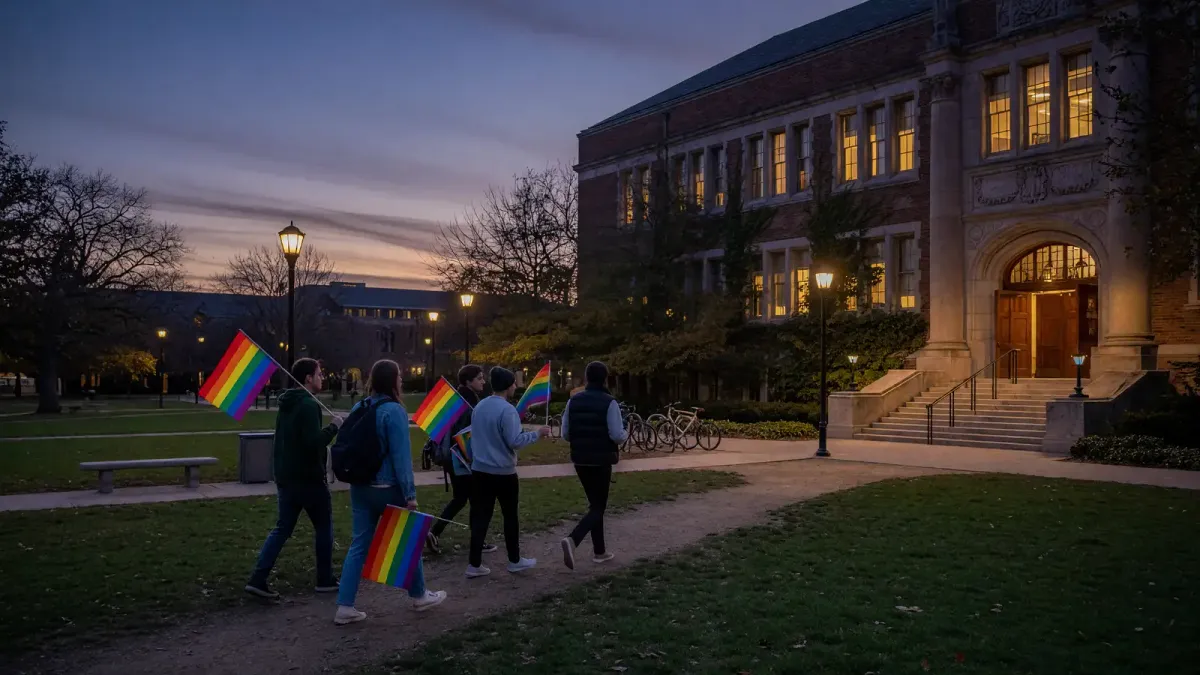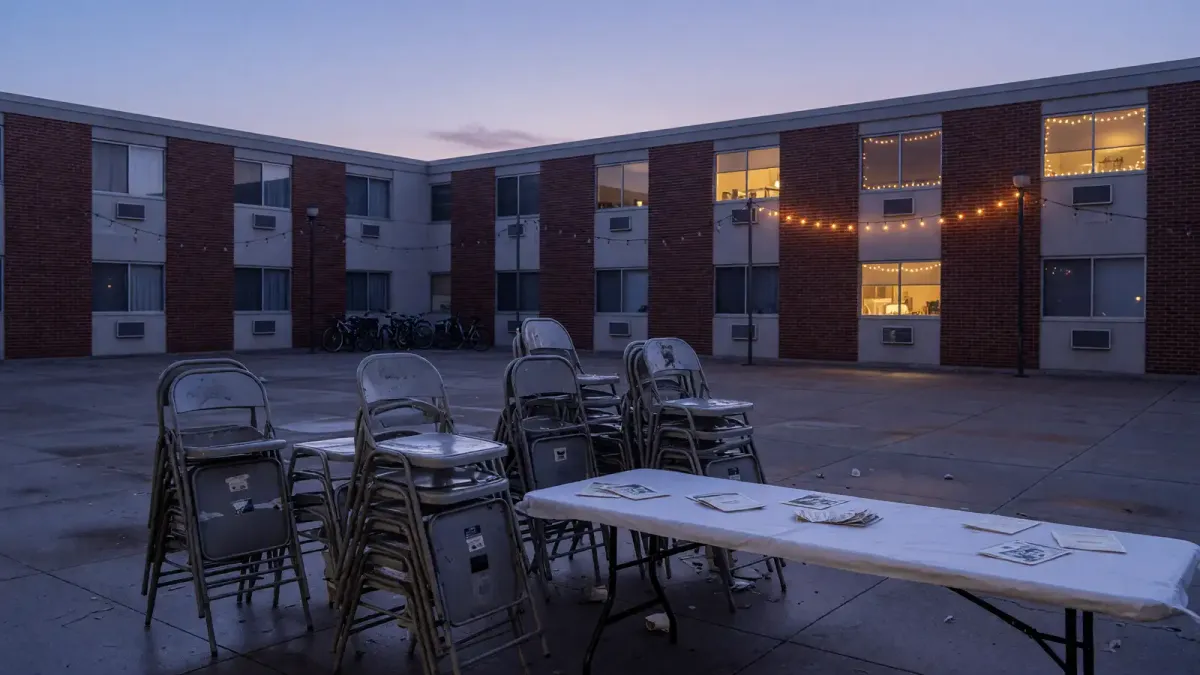
The Daily Titan put Thursday’s show in a courtyard, not in a PDF. Cal State Fullerton’s Housing Piazza. Spooky-themed drag, filed under LGBTQ+ History Month. The Losquadro Keller LGBTQ Resource Center hosted the annual show for National Coming Out week. Danna Granados shot it. Seats filled. People stood. Handouts on drag history went through the crowd. Flags, fans, glow sticks. Across the way, students in Juniper Hall held phones to the glass.
That is a night with a location. It is not office hours. We already wrote that CSUF’s nondiscrimination policy did not move when Title IX got rescinded. Different desk. Coming Out Day as a weekend still needs a Monday door. This week’s increment is the piazza at capacity, plus a Sac State exhibit that actually publishes an end date.
Capacity is a compliment and a planning failure
Standing room at a campus show means the programming worked. It also means someone undercounted chairs, or the piazza is the wrong shape for the crowd they now reliably get. Annual tradition, Abbey Miller told the Titan. She is a third-year communications major. If it is annual and it still overflows, the overflow is part of the design.
Mati Ochoa, third-year education major, talked about the community piece: people happy, getting out of class, meeting someone who is not on their group chat. That is the sentence student-affairs decks already want. Keep it, then ask the unglamorous question. Where do the people who arrived late stand without blocking housing traffic? Who holds the handouts when the stack runs out? Is there a quiet edge for students who will come for History Month but will not do a packed courtyard?
Glow sticks and fans are attendee labor. The campus did not have to invent joy. It had to pick a time and not cancel. Credit the Resource Center for hosting. Do not confuse a full piazza with a center that is open at 10 a.m. on a Wednesday in November.
If you are on a smaller campus copying this, the lesson is not “get a drag show.” The lesson is: put the show where residents can see it, and then staff the door that still exists after the last number. Juniper Hall’s phone lights only work if the hall is next to the courtyard. Your equivalent might be a dining-hall window. Or nothing. Do not fake a skyline of support you do not have.
Coming Out week is not History Month, and both still need a room
The Titan caption ties the show to National Coming Out week and to History Month in the headline. Those calendars overlap in October and they are not the same job. Coming Out week is a set of nights. History Month is thirty days of whether the office is still answering mail.
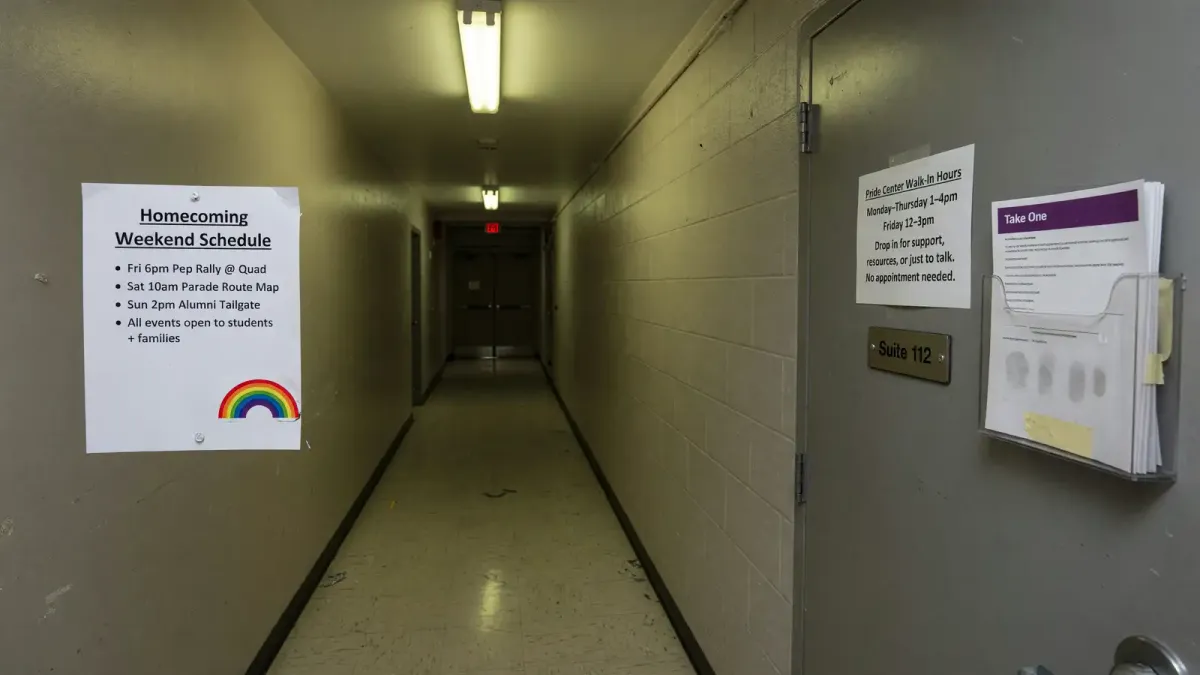
A spooky theme is seasonal dressing. It does not tell you whether the Resource Center’s hours survived the weekend. If you went because a friend forwarded the flyer, go back in daylight and write down the hours from the door, not from memory. The complaint URL and the counseling waitlist do not live in the piazza.
Documents on drag history being passed through the crowd is the pedagogical scrap. Someone printed something. That is more than a playlist. Ask the Center for the same one-pager in a form you can keep, because a courtyard handout becomes trash at 11 p.m. If they do not have a PDF, that is a content gap you can name without dunking on the performers.
Performers were students and local artists, the Titan says. That mix is how you avoid importing a show and calling it student life. It is also a labor question. Who got paid. Who got a ride. Who had a class at 8 a.m. Those answers will not be in a lifestyle write-up. They are the difference between a tradition and a burnout cycle.
Juniper Hall is the unbudgeted lighting plot
Phone lights in residence-hall windows are the image that will get screenshotted. They are also not a program. Nobody had to RSVP. Nobody had to be out. They had to live in that building and choose to participate from behind glass.
That is useful if you care about students who will not walk into a courtyard. It is useless if Housing treats it as proof that “the halls are inclusive” and then ignores the RA who still does not know how to handle a roommate conflict. Lights are cheap. Mediation is not.
If you live in a hall that faces nothing, you do not get this tableau. You get a Facebook event and a bus. Plan for that campus, not for Fullerton’s architecture.
For students who did stand in the piazza: the Titan describes an energetic crowd celebrating pride and self-expression. Fine. Also walk home with the Center’s hours and the reporting page. We already pointed at CSUF’s unchanged policy language. A show does not update a handbook. A handbook does not throw glow sticks. You need both, and only one of them was Thursday.
Mendocino 1000 has dates. Put them in your phone
The State Hornet is the other October object: an exhibit, not a night. “Rooted & Rising” started October 1 and runs through December 3. Location: Mendocino 1000. Dively, coordinator of the Anthropology Museum, needed a fall plan for that space. Hei Fok, director of the PRIDE Student Resource Center, helped turn it into a historical collection of LGBTQ+ presence on the Sacramento State campus. Newspaper articles, posters, artifacts, campus events.
December 3 is a deadline. Exhibits come down. If you are a student who will “go later,” later is a Saturday in November, not finals week. Write the room number down. Mendocino 1000 is more useful than “there’s something in the museum.”
Burke-Jones, in an email the Hornet quotes, splits the title. Rooted: people, movements, organizing, resistance, community care that made belonging possible. Rising: the work is not finished; queer communities keep building while hostility rises. That is a curatorial frame, not a vibe. It also means the show is arguing with the present, not only laminating the 1970s.
The 1970 unofficial club, and Associated Students at Sacramento State College v. Butz in 1971, are the persistence story the Hornet recaps: students and faculty trying to become official, hitting discrimination, staying anyway. If you only have an hour, read the case card and the 1970 origin before you photograph a poster for Instagram. The photograph without the case is decoration.
We already covered Sac State’s 20 years in a ballroom. A gala is a night. Mendocino 1000 is a room you can walk into on a random Thursday in October if the museum hours say so. Check those hours the same way you would check a Pride center. Museums close. Ballrooms lock.
Two campuses, two objects, one student job
Fullerton: a courtyard that overflowed. Sacramento: a gallery with a twelve-week run. Neither is a substitute for the other. If your campus can only afford one, pick the object that still exists on a gray Tuesday. For most campuses that is a room with a door, not a piazza. If you can afford both, do not let the show cannibalize the desk staff.
History Month as a gala with films in McConomy was the other flavor of October programming. Films need a screening room. Drag needs a stage or a courtyard. Exhibits need cases and a coordinator who already had to fill Mendocino 1000. All of those are facilities problems wearing rainbow graphics.
Practical pass for this week:
If you are at CSUF, go to Losquadro Keller in daylight and copy hours, reporting links, and whether they still have the drag-history handout as a file. If you lived the piazza, write down who looked overwhelmed at the edge so next year’s volunteer sheet is not a surprise.
If you are at Sac State, put December 3 on a calendar and walk Mendocino 1000 with one question: which artifact names a living office? If the answer is only history, ask Fok’s center what the current equivalent of the 1970 club is, and whether it has a key.
If you are elsewhere, do not copy the spooky theme and call it done. Copy the boring metadata: host office, named building, date, whether it overflowed, whether a residence hall could see it, whether an exhibit outlives the weekend. Then publish your own hours like they are part of the show, because they are.
Housing is the uncredited venue
The Titan puts the show at the Housing Piazza, not at a rented theater off Nutwood. That choice is why Juniper Hall could participate from windows. It is also why a noise complaint, a fire lane, and a resident trying to haul laundry through the crowd are Housing’s problem as much as Student Life’s.
If you are an RA in a building that faces a courtyard, Thursday was a test of whether you knew the event existed before the bass started. If Housing only found out from Instagram, next year’s overflow will include a resident who had a midterm and a neighbor who calls campus police because nobody posted a hallway note. A paper under the door is less glamorous than glow sticks. It is how you keep the hall from turning on the show.
Capacity reached, then standing: that is a headcount you can take to the fire marshal instead of to a vibes meeting. Count the chairs you set. Count the people who stood. Write both numbers on the after-action, with the time the first person sat on a planter. Next year you either add a second seating area or you ticket the courtyard. “Annual tradition” is not a variance.
Local drag artists plus students, per the Titan, means someone coordinated guests. Guest artists need water, a bathroom that is not in a locked hall, and a way out when the piazza empties. Student performers need the same plus a ride back to a dorm that may not face the courtyard. Put those lines on the same run-of-show as the spooky playlist.
What an exhibit requires that a courtyard does not
Dively had to fill Mendocino 1000 for a semester. That is a facilities sentence. Fok’s center supplied the through-line so the cases were not a random pride-flag collage. Burke-Jones’s Rooted / Rising split only works if the labels are long enough to argue. A courtyard show cannot carry a 1971 case citation. A vitrine can.
Newspaper articles and historical posters need rights, captions, and a person who knows which names are still living. Artifacts need loan forms. December 3 is when those loans go home. If a student worker is told to “take it down” on the 4th without a list, things walk. Assign the list now, in October, while the Hornet piece is still in the group chat.
The 1970 unofficial club is the ancestor of every unrecognized org that currently meets in a borrowed classroom. If your campus will not recognize a group, the Sac State story is not comfort. It is a reminder that unofficial is still a structure: a time, a faculty ally, a room even if the room is unofficial. Copy that, not the exhibit lighting.
Walk the gallery once without your phone. Then walk it again and photograph only the labels that include a living office, a still-used building, or a policy that is still in the handbook. Those three photos are the ones worth sending to a friend who will not come. The rest is atmosphere.
The Titan’s crowd was happy. Believe them. Then count chairs for next year, and keep the Resource Center’s door from becoming the thing you only remember when the piazza is dark.