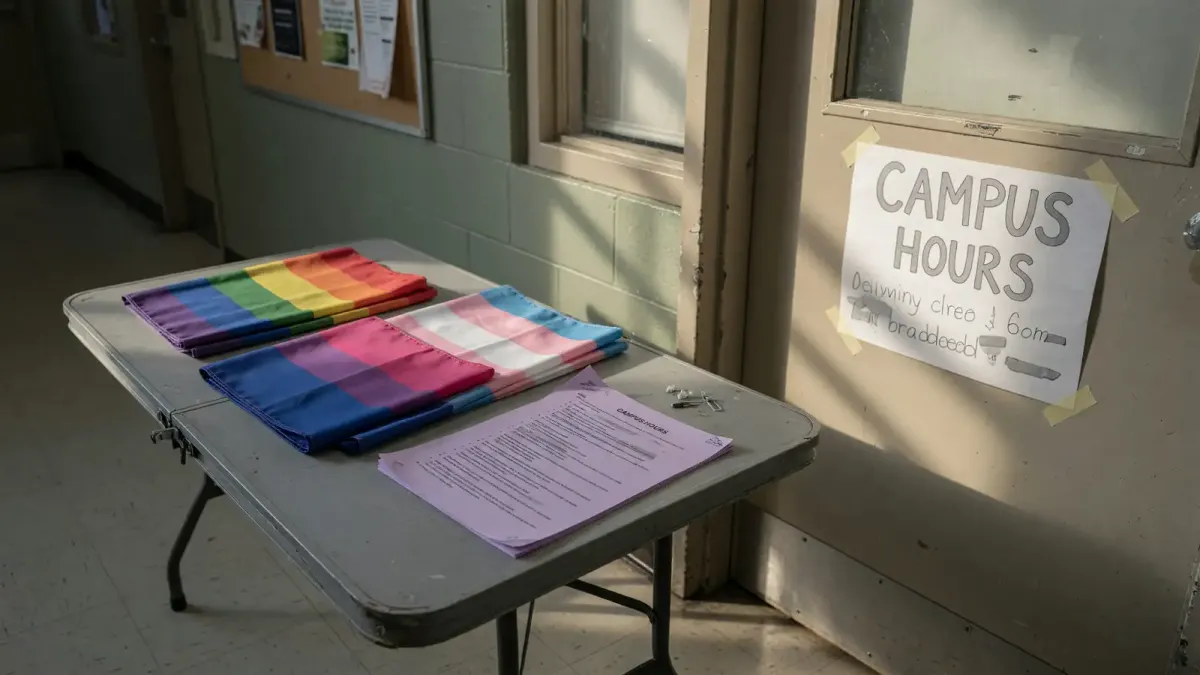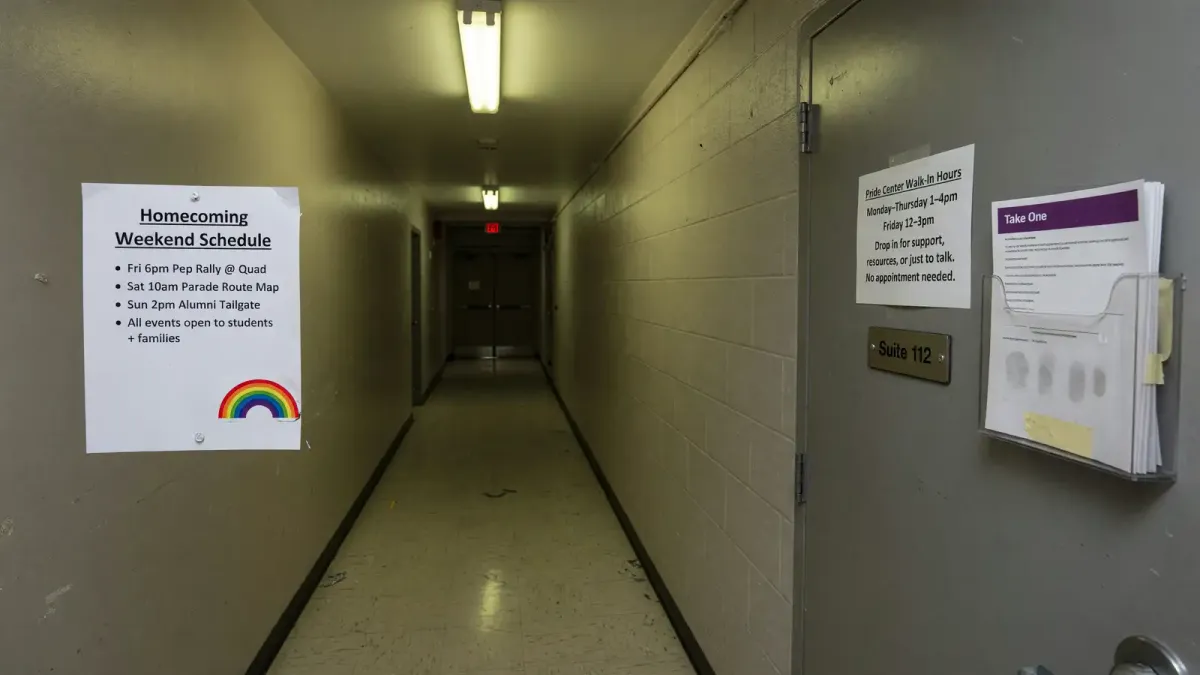
Cal State Fullerton’s History Month note opens with 1979 and 1987 and then tells Titans to go to a book display. That is the honest order. The month is a calendar. The Pollak Library shelf is a place you can stand. The Titan Pride Gala is October 22. If your campus only posted a flag graphic, you do not have programming. You have a color.
We already treated History Month as a building problem at SIU and homecoming as a calendar you have to check. This week is three campuses that actually published hours: a resource center with a founding date, a flagpole with a time, and an auditorium with five reel times.
October already had the dates. The campus still has to book the room
CSUF’s Culture and Institutional Excellence blurb reminds you why the month is October. Steve Ault and Joyce Hunter organized the first National March on Washington for Lesbian and Gay Rights on October 14, 1979. The second national march was October 11, 1987. Robert Eichberg and Jean O’Leary used that anniversary to set National Coming Out Day, which CSUF dates to 1989. Stockton’s flag-raising write-up adds the school-level origin: Rodney Wilson, a Missouri high school history teacher, created LGBTQ+ History Month in 1994; the NEA put it on the commemorative list the next year because Coming Out Day and the 1979 march were already in October.
None of that is a Tuesday plan. A first-year does not attend 1979. They attend a room. CSUF’s next sentence is the one that matters on a commuter campus: visit the Losquadro Keller LGBTQ+ Resource Center’s curated book display in the Pollak Library. The LKQRC, the same piece says, was founded on Coming Out Day in 2012. It lists coming-out support, a place to connect, and educational programs. That is a door. The gala on October 22 is a ticketed evening that honors student achievement. Both can be real. Only one is available between classes.
If your campus copied the 1979 paragraph and did not name a building, you got the press template. Ask for the room number. We already said a resource fair is a table. A book display is at least a shelf with a staffer nearby. Steal the shelf. Then ask when the center is open on Coming Out Day, not whether the president’s office “celebrates.”
Stockton raised the flag at a circle. The rest of the month is rooms with clocks
Stockton University raised a rainbow flag on October 1 at the Arts & Sciences Circle in Galloway, New Jersey, the annual kickoff. Students from the Pride Alliance and the Queer and Trans People of Color Alliance spoke. Jecce Carmen, Pride Alliance president, called the flag “a powerful symbol of visibility, of belonging, and of hope.” A flag is a photograph. Stockton also published the follow-up times.
LGBTQ+ Careers Panel, 4:30 p.m., October 6, Board of Trustees Room. Professional panelists on advocacy and health fields. Story Space: My Coming Out Story, 5 p.m., October 14, Multicultural Center. LGBTQ+ History Trivia & Tunes, noon to 3 p.m., October 22, Campus Center Coffeehouse. The university says the website has the full list plus on-campus resources. That is the product. The flag is the poster.
October 6 is already on the calendar as you read this. If you are not at Stockton, the transferable object is the pairing: one outdoor ritual, then indoor events with a building name. A careers panel in a trustees room is a different job than a coffeehouse trivia block. One is alumni and majors. The other is a Wednesday you can walk into without a blazer. Campuses that only do the flag skip the part where a freshman talks.
Coming Out Day is October 11. Stockton put Story Space on October 14, the 1979 march anniversary, in the Multicultural Center. That is a storytelling series, not a lecture. If your campus’s Coming Out Day is a social-media graphic, ask for a room like that. You do not need Stockton’s names. You need a time and a staffer who will still be there if three people show up.
Reel Q is a city festival. Five of the films are on campus
Hannah Considine’s Tartan dispatch, dated October 5, is the campus-life version of History Month that does not wait for a gala. Reel Q is Pittsburgh’s longest-running film festival, and the piece calls it the sixth longest-running LGBTQ+ film festival in the world. It started in 1982 as the Lesbian and Gay Film Series and became an annual festival in 1985. This is the 41st season. It runs October 2–10.
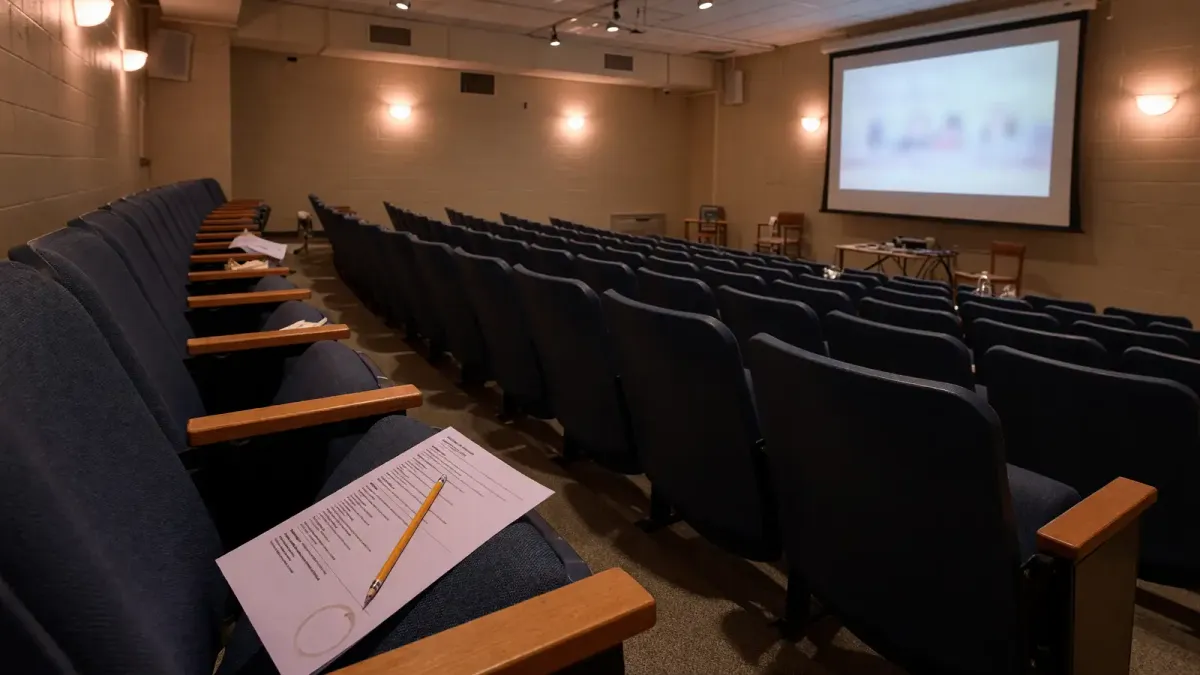
Venues are scattered on purpose: Row House Cinema in Lawrenceville and Hollywood, a sapphic cafe (the article uses Soft Spot and Sweet Spot), Melwood Screening Room, Harris Theater, Club Cafe, City of Asylum, and Carnegie Mellon’s McConomy Auditorium. The campus block is specific. Five films in McConomy: October 9 at 6:30 and 8:30 p.m., October 10 at 2:00, 4:00, and 6:00 p.m. Considine’s closer is not subtle. “There’s literally some showings on campus!!!”
That is the steal. A city festival that puts product in the auditorium you already walk past is worth more than a month graphic in the union. If your campus has a film series budget and no Pride programming, this is the cheapest History Month: license the work, dim the lights, put a resource table in the lobby, leave when the credits end. You do not have to invent a gala.
T.J. Murphy, Reel Q’s executive director, said pay-what-you-can is in its second year and that last year they made the same or more than in ticketed years, because people who could pay more did and people who could not still came. For a student org, that is the access policy. A $12 “suggested” ticket that is actually required is a filter. A jar is a filter you can ignore. Murphy also said submissions have been near-record almost every year since 2019, almost 400 this year, from a volunteer programming committee anyone can join. If your campus film club is three officers and a locked Google Drive, that sentence is the how-to.
The shorts were a cafe. The CMU credit is an archive
Considine went to the October 3 cafe block. Murphy called it a community event rather than a traditional theater, and said the festival needs both: films shown as they were made, and a room where people talk. The first program, “Short & Sweet,” was six shorts, eight to 25 minutes. Titles Considine logged: “Baker’s Boy” (Mo Schweiger), the documentary “Pittsburgh is Freezing” on drag performers JoeMyGosh and Snoozy Q, the Arabic animation “From Male To Female,” “Las Cosas Que Brillan,” and “We’re Still Here.” The feature was “In A Whisper,” French and Arabic, a trip back to Tunisia.
“We’re Still Here” is the campus object. Director Zarmond Danger Goodman graduated from Carnegie Mellon in May 2026 with a BA in Film and Visual Media, shot the short as a final for Advanced Film Production after coming out to family, and put CMU students and staff on camera. Goodman interned with Reel Q in 2024 to archive the festival’s screenings, “one of the first queer communities outside of [Carnegie Mellon]” they joined, because they wanted Pittsburgh people, not only campus people.
Goodman on archiving: when crises hit, “it’s … the people being oppressed information that’s the first to go.” The films are entertainment and also a record of queer life. That is a student-job description. If your Pride org’s Instagram is the only record of last year’s events, you have a feed, not an archive. A shared drive with titles, dates, and who showed up is less glamorous than a gala and more useful in four years.
Considine’s cafe notes are useful as a programming checklist even if you never go to Pittsburgh. “Baker’s Boy” mixed testosterone-gel comedy with the cost of care and doctors who do not get it. “Pittsburgh is Freezing” followed local drag without requiring the viewer to already be in that room. “From Male To Female” put an intersex 15-year-old, Salmia, in Arabic-language animation. “Las Cosas Que Brillan” was a trans Latinx mermaid story Considine felt was the least “LGBTQ-themed” of the shorts, which is a reminder that a festival slate is allowed to be uneven. The feature, “In A Whisper,” sat with death, homophobia, and a family that did not know. A campus series that only books coming-out comedies is not History Month. It is a brand.
Murphy wanted both a proper theater and a hangout. McConomy is the first. The cafe is the second. If your campus only has the union movie night, you already have McConomy. Add a table with LKQRC-style resource cards in the lobby. Do not require a club membership to sit down.
You do not need to like Considine’s reviews. You need the showtimes and the fact that a 2026 CMU alum’s class project is in the city festival. That is campus life leaking the right direction: out of the auditorium, not only into it.
Copy the hours. Leave the month graphic if you must
CSUF: library display now, LKQRC since 2012, gala October 22. Stockton: flag already raised October 1, careers panel October 6, Story Space October 14, trivia October 22, plus a resource list. CMU: McConomy October 9 and 10, five reels, pay-what-you-can city festival in its 41st year. Three different products. Same test. Can a student show up without knowing a dean?
Stockton’s origin paragraph is the one student journalists will copy, so copy it accurately. Wilson in 1994, NEA the next year, October because Coming Out Day is the 11th and the first march was the 14th in 1979. CSUF’s piece dates Coming Out Day to 1989 via Eichberg and O’Leary after the 1987 march. Those are two layers of the same month. Neither layer opens a door. The LKQRC founding on Coming Out Day 2012 is the door with a birthday.
If you are booking campus life for the rest of October, the stealable grid is: one outdoor ritual (Stockton’s circle), one library object (CSUF’s display), one careers or story night with a room name, one film block in a hall students already enter. Reel Q’s pay-what-you-can is the ticket policy. McConomy’s five times are the calendar.
History Month will be used as proof that the campus “did something.” A flag photo is something. A film in McConomy is a seat. If your school has a Pride Center, take the hours, not the selfie. If it does not, SIU already showed what a month looks like without a door. Borrow Stockton’s event list format and Reel Q’s auditorium grab. The 1979 march does not need another paraphrase. The 6:30 p.m. showing does.