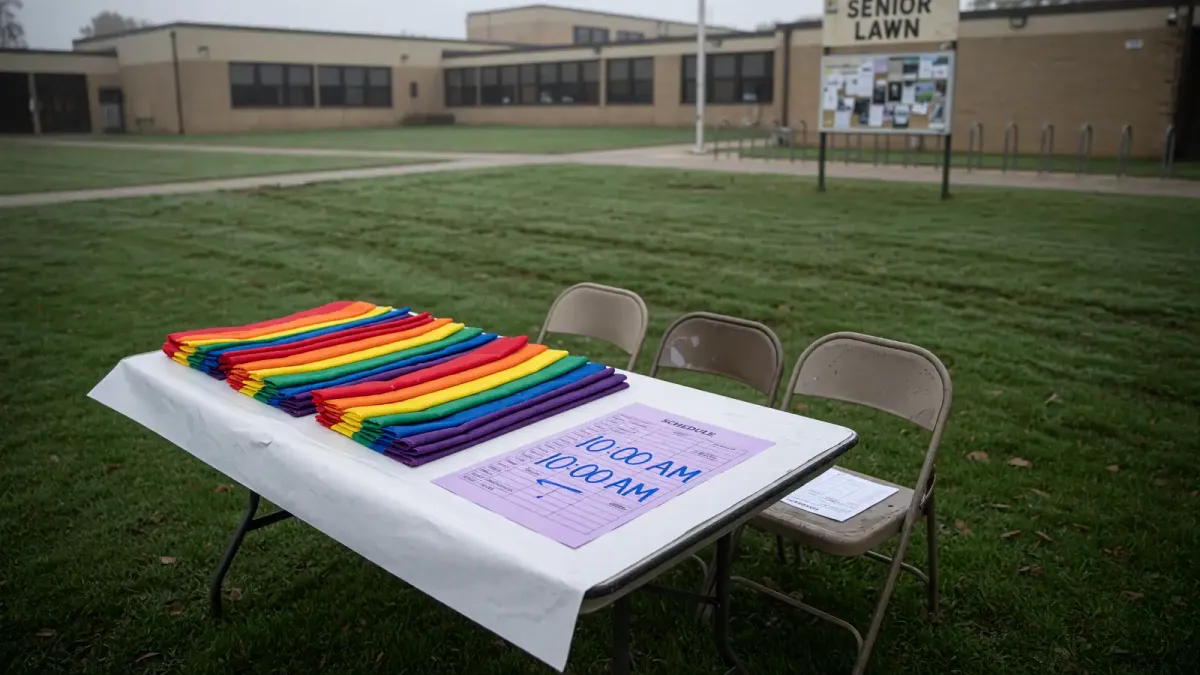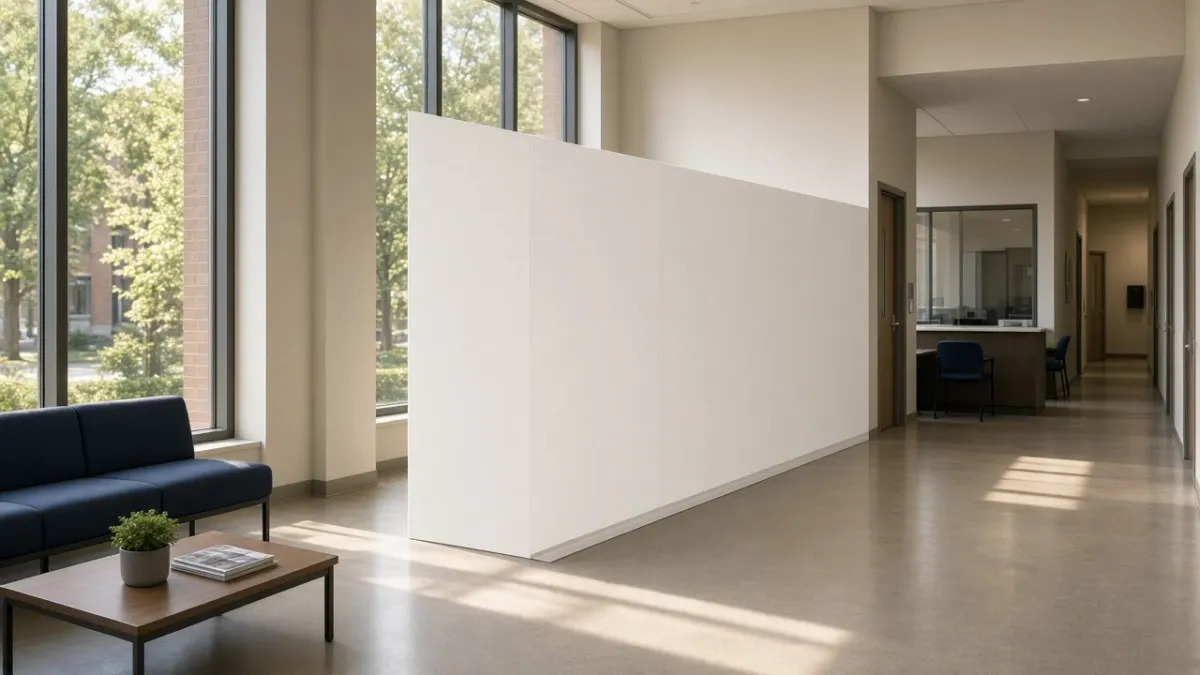
For about four years, students walking through the Student Services Building Addition at the University of Texas at Dallas could see a full-wall Pride flag mural with the words “You belong here” beside the university logo. Dallas Observer reporter Hannah Everett wrote on 11 November 2026 that the mural is now behind a white temporary wall. Student government members say the cover-up, and a quiet end to gender-inclusive housing for incoming students, went past what Texas law required. The administration, according to those students, has said the mural will come down for good and will not directly back a replacement.
That is a campus fight about symbols, housing options, and who gets a meeting before a decision. It is not the same case as the federal argument over parent access to gender-identity records in schools, which Katie King laid out the same week for the University of Baltimore Law Review. The two stories still belong in one conversation. Students arrive at college from school systems where name, pronoun, and gender-identity notes are already a legal battleground. A university that removes a welcome mural and a housing opt-in without a public explanation is making a climate decision on top of that.
What students say changed, and when
Everett reports that the Pride Wall had been in the student-services addition since 2022. The white wall in front of it is tied to renovations the university had been considering since the previous spring. Students told her they did not know the renovation would take the mural with it.
The removal date she records is 3 July. A right-wing influencer, Chaya Raichik, who posts as Libs of TikTok, had put a photo of the mural on X and asked whether it violated Senate Bill 17, tagging Governor Greg Abbott. State Representative Brian Harrison’s attention followed. Students told Everett the university took the mural down fast, faster than they were used to seeing.
Student Government member Colton Rupe called the wall “the nail in the coffin.” He said many students came to him about how much it hurt, and that they felt they could not just be a student, which is what they had come to campus to do. Senior Rose Saenz, who organizes pride events, described a university that folds more quickly under political pressure, especially after the previous president was removed. She called the Pride Wall episode a small amount of pressure and a fast buckle.
Rupe and fellow Student Government member Nivedha Maniv, with another member, drafted a resolution asking the administration to bring the artwork back and to commit to clearer communication. Rupe told Everett the response so far is that the mural will be removed permanently, and that the administration will not directly support an alternative. Maniv’s criticism is procedural. She said administrators should talk to students before decisions of this size, and that skipping that conversation is where compliance turns into over-compliance.
Rupe also said that since the mural went, students have described the campus as unsafe and unwelcome. He and Maniv told Everett they have spoken with dozens of students who share a sense of betrayal and anger. Those are student reports to student government and to a reporter. They are not a climate survey with a published response rate. They are still the record Everett was able to gather in November.
The statutes students say do not require this
Two Texas laws sit in the background of the student argument, and Everett states them without treating them as a court ruling on the mural.
Senate Bill 17, signed by Governor Greg Abbott in 2023, banned diversity, equity, and inclusion offices at public colleges and universities. Senate Bill 2972 took effect in 2025 and required schools to rewrite policies on speech, expression, and assembly, including how, when, and where students and faculty may demonstrate.
Students told Everett they understand that public universities have to follow state law if they want to keep funding. Their objection is that the Pride Wall and cuts to gender studies looked like choices, not mandates. Rupe said the wall coming down a couple of days after Pride Month ended was the moment he had evidence for a shift he had already felt. “That felt like an action they didn’t have to take that they chose to take,” he told Everett.
This desk cannot confirm, from the Observer story alone, what legal advice the university relied on when it covered the mural. Raichik’s post asked whether the wall violated SB 17. Asking is not a holding. Harrison’s interest is political pressure, which Saenz treats as the thing the administration answered. Until the university publishes the policy memo, students are arguing from the speed of the removal and from the absence of a student meeting. That is a fair description of the process they experienced. It is not, by itself, a finding that SB 17 compelled the paint.
The resolution is the on-campus remedy they chose: put the request in student-government form, ask for the art, and ask for a promise of notice next time. The answer Rupe reports, permanent removal and no direct support for a substitute, closes the art question from the administration’s side while leaving the trust question open. A campus can comply with a speech statute and still decide whether a mural stays. Students are saying the second decision was made as if it were the first.
Gender-inclusive housing left the portal without a note
The mural is the visible change. Everett also reports a housing change from March that students found by absence.
UT Dallas stopped offering gender-inclusive housing to incoming students. The opt-in disappeared from the housing portal. Everett writes that there was no notice and no announcement. Mixed-gender housing had started in 2017 and was the first arrangement of its kind in the UT System. The point, as she describes it, was to let LGBTQ+ students feel safer in university housing by assigning roommates without the usual single-gender rule.
Rupe said students learned about the rollback when they could not find the option and contacted housing. That is a bad way to discover a policy. A portal field that vanishes is not a forum. Students who needed the option for safety reasons found out by failing to complete a form, then had to chase an office for an explanation the office had not published.
Housing policy and a mural are different tools. One assigns beds. One assigns a message in a hallway that every student uses. Taking both down in the same political season, one loudly after a viral post and one quietly in a form, is why student leaders are treating them as one pattern. Maniv’s “over-compliance” phrase is their name for that pattern: actions they believe the statutes did not force, taken without the discussion they believe a public university owes the people who live there.
Readers looking for how other campuses staff a day-to-day support office, as distinct from a mural, can compare this with the note on campus LGBTQ+ resource centers. UTD’s November story is about what happens when symbols and a housing checkbox go away, not about how a funded center schedules drop-in hours.
A parallel fight over records, not over paint
King’s University of Baltimore Law Review essay, posted 11 November 2026, is about the Family Educational Rights and Privacy Act, student gender identity, and what courts do with agency readings of statutes after Loper Bright. It is not a report on UT Dallas. It is the legal weather around names and pronouns in education records, which is the paperwork version of the belonging question the mural stated in paint.
FERPA, King writes, lets parents access their children’s education records. Those records are materials an educational agency or institution maintains that contain information directly related to a student. Most of them are open to parents. One narrow exception covers notes the author keeps as a personal memory aid and does not make available to anyone else. King says that exception may cover a teacher or administrator’s note of a preferred name, pronouns, or gender identity, if the note actually meets those criteria.
She also records that fifteen states require some degree of disclosure to parents when a student asks to use a different name or pronoun, citing a Movement Advancement Project map she last checked on 30 August 2026. The U.S. Department of Education’s position, as she summarizes it, is that FERPA bars schools from cutting parents off from records that mention a student’s gender transition.
The enforcement King tracks is already in court. In early 2026 the Department found the California Department of Education in violation, pointing to gender support plans and to pressure on a student-information vendor to hide pronouns. California sued. The complaint, California v. U.S. Department of Education, No. 3:26-cv-01259, in the Northern District of California, is dated 11 February 2026 in King’s footnotes. In October 2026 the Department of Justice sued Anne Arundel County Public Schools in Maryland, alleging that staff were told to solicit, document, and act on a student’s self-identified name, pronouns, and gender identity without telling parents. King’s citation for that suit is a Justice Department release dated 27 October 2026. She adds that other state education departments are under investigation, pointing back to a 27 July 2026 Department of Education press release.
California’s reply, as King presents it, is that FERPA requires inspection when a parent asks, not a duty to push the information out unasked. The complaint also says the state need not be perfectly FERPA-compliant to avoid penalties. There is no private right of action, so a parent cannot sue under FERPA itself. The sanction the Department can threaten is losing federal money. King writes that the threat has been made and the sanction has not been imposed.
Numbers in the essay should stay attached to her sources. She cites Herman and Flores at the Williams Institute (2025) for an estimate that about 724,000 children in the United States aged 13 to 17 identify as transgender, about 3.3 percent of that age group, and about 25.3 percent of the country’s transgender population. She cites a 2021 Saint Louis University School of Medicine paper, Zaliznyak and colleagues, for a finding that among 155 transgender adults in that study, a majority had begun questioning gender identity on average between ages three and seven. Those figures describe a population. They do not measure UTD, and they are not a treatment recommendation.
Loper Bright Enterprises v. Raimondo, decided in 2024, is the reason King thinks the next round of cases will not simply ratify the Department’s reading. The Supreme Court dropped Chevron deference. Courts now have to decide for themselves whether an agency stayed inside the statute. King expects circuit splits and, eventually, a petition the Supreme Court might take. Until then, she writes, a lot depends on whether a school system gives in when the Department knocks, or refuses and litigates.
What college students can and cannot take from either story
UT Dallas is a university. King’s essay is mostly about schools and state education departments, and about parents’ access to children’s records. This piece will not invent a rule about when FERPA rights move from parent to student. King does not settle that question in the pages reviewed here. What she does settle is that name, pronoun, and gender-identity notes are already the subject of findings, a state lawsuit against the Department, and a Justice Department suit against a county system.
A student who just left one of those districts and then cannot find gender-inclusive housing on a UTD portal is meeting two different institutions with two different silences. The K-12 fight is about who may see a record. The UTD fight Everett documented is about whether a mural and a roommate option survive, and whether students hear about it before the form changes. Conflating them would be a mistake. Ignoring the sequence would also be a mistake. Campus climate is not only what a university paints. It is what students already expect institutions to hide or announce.
The student-government resolution is a limited tool, and that is a reason to describe it accurately. It asks for the art and for transparency. It does not appropriate a budget, rewrite SB 17, or restore a housing code. Its force is the record: a dated request, and a reported answer that the mural is gone for good. Future students can read that even if this year’s portal never explains the March change.
Maniv’s point about notice is the part other campuses can use without adopting UTD’s politics. If a renovation will cover a mural students treat as a welcome, say so before the drywall goes up. If a housing opt-in is ending, put the sentence on the page where the checkbox used to be. Speed after a viral post reads, to the students Everett quoted, like capitulation. Silence in a portal reads like the same decision made where fewer people will see it.
Saenz and Rupe are also clear that some students are speaking and some are still afraid of consequences. Everett’s headline, echoed by the Observer’s 12 November post, says students had been too scared to speak until now. The people on the record in her story are student-government members and a pride-event organizer. That is not the whole student body. It is the group willing to attach names. A university that answers only those names, and only by confirming the mural will not return, has not held the conversation Maniv asked for.
None of this requires a verdict on whether SB 17’s text reaches a painted flag. The students’ claim is that the university chose, and chose fast, and did not ask them. The administration’s reported claim is that the mural is permanently gone and will not be replaced with official support. Those two sentences are the dispute. The FERPA cases will not decide them. They do tell incoming students that fights over names and pronouns are not theoretical by the time they reach a college housing form.
Everett’s reporting is local, dated, and sourced to named students. King’s essay is a legal survey with footnotes, not a dispatch from Richardson. Read them as a pair if you want both the hallway and the statute book. Read them separately if you are trying to learn what UTD did in March and July. The hallway facts are Everett’s. The docket facts are King’s. The analysis worth keeping is that a welcome can be withdrawn in paint and in a dropdown menu, and that students noticed both.