Campus LGBTQ+ resource centers coordinate practical student support every week by managing physical rooms, staffing drop-in hours, and solving administrative problems that classroom instructors rarely see. When an institution marks an anniversary or hosts an annual campus festival, public attention focuses on speeches and ceremonial gatherings. The daily survival of queer and transgender students, however, depends on whether someone is sitting behind a front desk at 9:00 a.m. to help update a student record, distribute chest-binding supplies, or resolve a housing placement dispute.
On November 2, 2026, Ithaca College published reporting documenting the twenty-five-year history of its Center for LGBT Education, Outreach, & Services on South Hill. The center traces its beginning to a 1999 proposal drafted jointly by students, staff, and faculty, opening its doors formally in the fall of 2001. On November 3, 2026, regional outlet FingerLakes1 reported on the center’s schedule, noting that alongside its upcoming anniversary event on November 8, the office handles steady casework for digital name updates, housing navigation, restroom mapping, and student scholarships under director Crissi Dalfonzo.
Understanding how established centers structure these functions shows what effective campus support requires in 2026, especially as legislative changes and administrative reorganizations complicate resource delivery across American higher education.
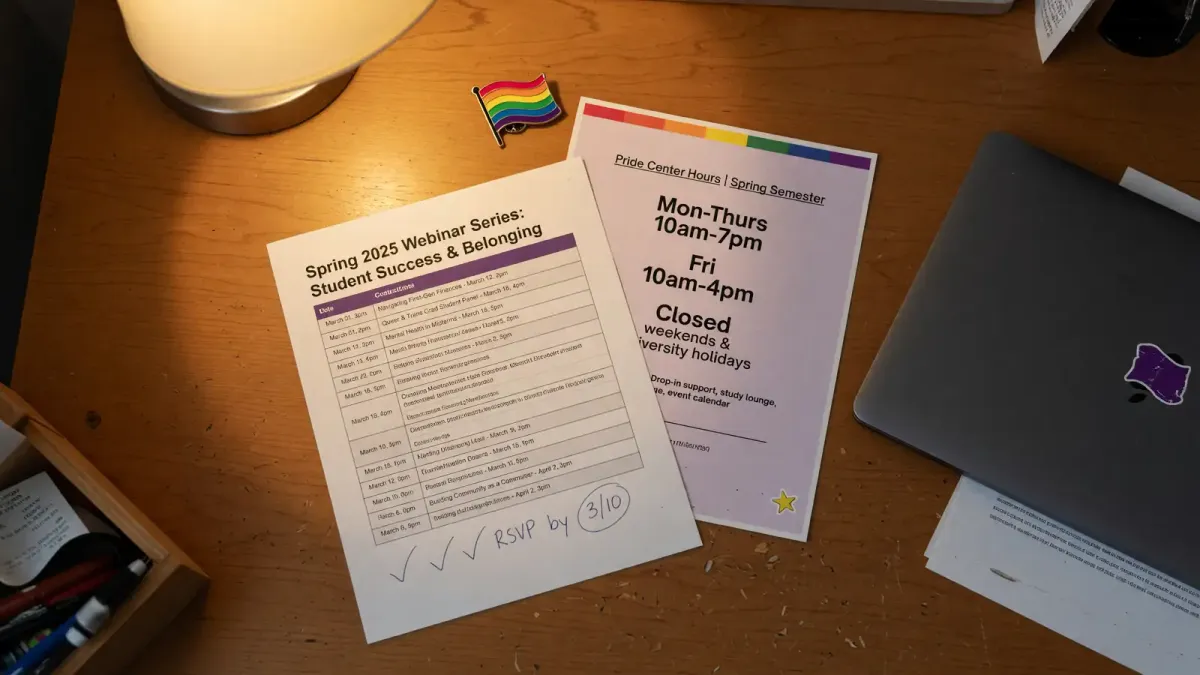
Daily operating hours at campus LGBTQ+ resource centers
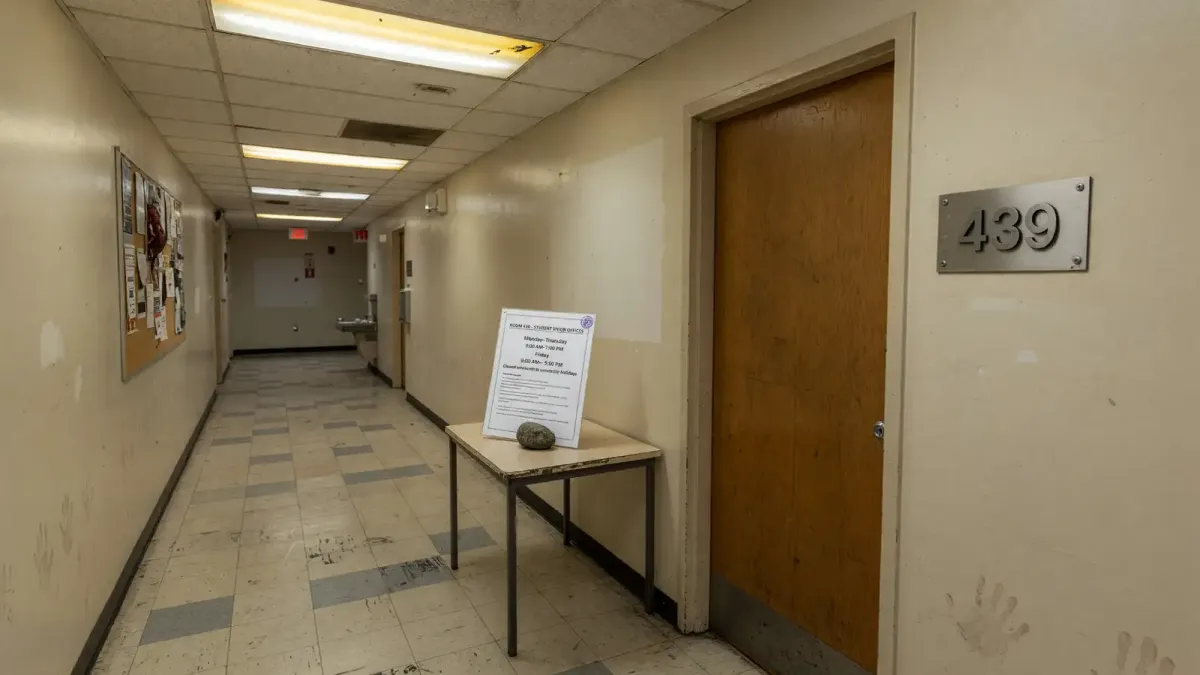
A campus resource center operates first as a physical facility with published hours. Ithaca College houses its Center for LGBT Education, Outreach, & Services in Towers Concourse, Suite 110. The suite contains a central lounge, a dedicated relaxation room, a lending library of books and periodicals, computer workstations, and a small kitchen stocked with coffee and tea.
The baseline schedule matters because students often seek assistance between classes or during sudden housing or academic emergencies. At Ithaca, professional staff maintain open doors Monday through Friday from 8:30 a.m. to 5:00 p.m. When an office maintains regular weekday hours, students can drop in without filing formal appointments weeks in advance.
Physical rooms provide shelter from public scrutiny in campus common areas. For a student who has not disclosed their sexual orientation or gender identity to roommates, a resource center lounge offers space to study, charge a phone, or eat lunch without defensive monitoring. As examined in our look at campus community resource center schedules, an institution may print promotional banners for awareness weeks, but the utility of any center rests on whether the door is unlocked when a student arrives.
When universities reduce operating hours or consolidate identity offices into shared multicultural suites without dedicated staff, students lose the predictability required to seek sensitive help. Knowing that Suite 110 has someone present every weekday morning allows students to plan difficult administrative conversations around their class schedules.
Digital name updates and registrar navigation
Updating a chosen name across university computer networks is one of the most frequent requests campus resource centers handle. While universities often advertise inclusive policies, their digital infrastructures frequently lag behind. A student who updates their preferred name in a central admissions portal can still find their legal name displayed on classroom roll sheets, public Canvas forums, campus card swipe terminals, dining hall cash registers, or mailroom packages.
Resource center directors and staff coordinators step into this gap by guiding students through registrar protocols. At Ithaca College, the center assists students directly with digital name updates across campus systems, verifying that changes populate correctly in administrative directories without demanding costly legal name changes through county courts.
Discrepancies in university IT databases create immediate privacy risks. If a professor calls out a legal birth name during first-day attendance, the student faces involuntary disclosure in front of dozens of peers. Center staff maintain working relationships with campus registrars, IT help desks, and campus card offices to intercept these synchronization errors.
Students navigating these procedures should take several practical steps:
First, check the official registrar policy to identify which campus databases sync automatically and which systems require manual paperwork. Some platforms, such as campus health centers or financial aid software linked to federal Title IV funds, must legally retain formal government names until a court order is filed.
Second, request that the resource center verify internal directories before the semester begins. Staff can check whether campus email aliases (for example, username display handles) reflect chosen names instead of initial admissions files.
Third, obtain written confirmation from the campus card office regarding how student ID cards display primary names. Many institutions now print preferred names on the front face of cards while storing legal identifiers invisibly on the magnetic strip or internal chip.
Gender affirmation closets and material support
Material support programs represent another concrete service managed directly by campus centers. Many LGBTQ+ students arrive at college without wardrobes that match their gender presentation, often because of family surveillance, lack of personal income, or anxiety about shopping in retail stores.
To address these barriers, resource centers establish permanent clothing exchanges. Ithaca College operates an on-site Gender Affirming Closet where students can select everyday apparel, business attire, and winter coats free of charge. These operations run without income verification or checkout fees, allowing students to try on clothes in private fitting areas without having to justify their identity to a store clerk.
Beyond general apparel, specialized centers supply essential gender-affirming undergarments. Ithaca’s center runs the BAM! program, short for Binders and More. Under this initiative, any enrolled student can request one free gender-affirming garment per academic year, choosing among chest binders, flattening tape, or gaff and tucking undergarments.
The program includes clear physical health guidelines. Staff distribute manufacturer sizing charts and educational instructions on safe wear duration, advising students not to compress tissue for more than eight consecutive hours or wear binders while exercising or sleeping. Supplying high-quality gear prevents students from resorting to dangerous alternatives like duct tape or plastic wrap, which can cause rib fractures, skin tearing, and chronic breathing restriction.
When evaluating whether a campus provides authentic assistance, students should examine whether material resources like clothing closets and chest-wear programs exist as permanent budget lines or temporary volunteer drives. As outlined in our guide to evaluating campus support resources, sustained funding for basic material needs indicates whether a university views trans inclusion as practical student retention or mere marketing copy.
Peer advising and evening coverage across student schedules
Standard business hours do not always fit undergraduate schedules. Laboratory sections, campus dining shifts, athletics, and off-campus jobs frequently keep students occupied from 9:00 a.m. to 5:00 p.m.
To ensure continuous coverage, established centers hire undergraduate and graduate student assistants to extend building availability. Ithaca College supplements its professional staff hours with evening shifts operated by student workers and Pride Fellow Cefari Langford.
Peer staff provide a distinct layer of institutional access. Many first-year students hesitate to approach a professional director because administrative offices can feel formal and intimidating. Talking to an upper-level student employee sitting at a desk offers a lower-barrier entry point.
Student employees perform several essential daily tasks:
- They orient visitors to physical amenities, such as where to find the lending library, kitchen appliances, or private restroom locations.
- They answer informal questions regarding which academic departments have welcoming faculty, which campus physicians understand hormone therapy, or how specific student organizations organize their weekly meetings.
- They staff evening study hours, providing quiet workspaces where students can work on assignments alongside peers who share their background.
- They monitor supply levels in community pantries and clothing closets, ensuring shelves remain organized and restocked.
Establishing formal fellow and student staff positions also supplies queer student leaders with campus employment, professional mentorship, and direct experience in student affairs administration.
Connecting campus desks to student health networks
Accurate, nonjudgmental health education remains a vital responsibility for campus resource staff. Many students enter higher education from secondary school systems that restricted or eliminated comprehensive sex education.
In the Ithaca College reporting, one first-year student, identified as C.H. ‘29, described arriving on campus after attending a high school with abstinence-only instruction that offered no information about queer relationships or sexual wellness. Discovering the center’s health programming provided their first exposure to inclusive sexual health education without shame or stigma.
Campus centers address these educational gaps by offering free safer-sex supplies, including barrier methods such as internal and external condoms, dental dams, and water-based lubricants. Staff also distribute factual literature covering routine STI screening intervals, pre-exposure prophylaxis (PrEP) access, and healthy relationship dynamics.
Equally important is the center’s role as a referral bridge to campus and community medical providers. Resource directors help students navigate student health insurance policies (such as understanding deductible tiers or coverage for preventative care). They also connect students to affirming mental health counselors who understand minority stress, family estrangement, and the social pressures facing LGBTQ+ young adults.
Students preparing to access campus health services can benefit from taking proactive steps before an appointment:
Review your university student health center website to check if clinical staff have completed specific LGBTQ+ cultural competency training.
Visit the resource center desk to ask if staff maintain an informal referral directory of local practitioners who have positive reputations among current students.
Confirm privacy protocols at the health center, especially if you remain on a parent or guardian’s insurance policy where Explanations of Benefits (EOB) statements might be mailed to a home address.
These practical preparations help students avoid medical discrimination and secure needed care early in the term, as detailed in our guide on locating campus support systems proactively.
Why decentralized direct access protects student welfare
Our editorial perspective at Pride Campus is that the durability of campus LGBTQ+ support depends on embedding operational services deep into daily university life instead of relying on high-profile public celebrations.
Higher education currently faces intense political turbulence. Over the past three years, state legislatures in multiple regions have mandated the closure or restructuring of campus diversity offices, leading to the dissolution of long-standing resource centers and the elimination of staff positions. According to data tracked by the Consortium of Higher Education LGBT Resource Professionals through its Center Closures Project, out of nearly 4,000 degree-granting colleges and universities in the United States, only about 300 have historically maintained dedicated Gender and Sexuality Centers, and that modest number faces continued administrative pressure.
When an institution’s commitment to queer students exists primarily as a calendar of public events, awards ceremonies, or marketing statements, that commitment can evaporate as soon as governing boards or state officials demand cuts. A commemorative banquet or a pride week parade cannot step in to resolve a registrar error, replace a damaged chest binder, or provide a safe study chair during midterms.
In contrast, centers that prioritize concrete material aid build lasting student safety:
First, physical distribution programs like the Gender Affirming Closet and the BAM! program solve acute physical needs. A student who receives safe clothing or compression garments experiences immediate relief from dysphoria and financial stress, which directly supports their ability to stay enrolled and attend class.
Second, integrating name change protocols and restroom mapping into general campus systems establishes administrative precedent. Once a registrar’s software incorporates streamlined fields for student identity, that procedural pipeline remains functional even if institutional rhetoric shifts.
Third, training student staff and pride fellows creates decentralized networks of institutional knowledge. Upper-level students pass practical navigation strategies down to first-year cohorts, teaching them how to locate affirming professors, secure emergency housing, and access local crisis support regardless of administrative turnover.
Ceremonies like Ithaca College’s Silver & Sequins celebration on November 8 provide valuable opportunities to reflect on twenty-five years of campus advocacy. But the real measure of that history lies in the fact that on Monday morning, the doors of Suite 110 in Towers Concourse will unlock at 8:30 a.m., professional staff and student fellows will be on duty, and any student needing an administrative advocate, a warm cup of coffee, or a binder will find someone ready to assist them.
Practical steps for finding support on your campus
If you are trying to locate or use LGBTQ+ support services on your own campus, several direct steps can help you get started:
Search your college website for the designated pride center, gender and sexuality resource room, or student life office. Record the room number, building address, and current weekday drop-in hours.
Check your registrar portal for instructions on updating your preferred name across class rosters, Canvas accounts, and campus identification cards. If instructions are unclear, visit the center to request staff assistance.
Ask center staff whether the university operates a free clothing exchange, basic needs pantry, or binder distribution program.
Review the center calendar to see if peer staff host evening study sessions, discussion groups, or social drop-ins after standard office hours.
Request a list of campus and local medical providers who understand LGBTQ+ healthcare, and clarify student insurance billing procedures before scheduling appointments.
Maintaining strong connections with campus resource centers ensures that you have access to both community connections and institutional advocacy throughout your academic journey.
Health and safety note: Information regarding chest binders and compression garments is intended for educational purposes and should not be taken as medical advice. Always follow manufacturer sizing guidelines, avoid over-compression, and consult a qualified healthcare professional if you experience persistent pain, shortness of breath, or skin irritation.
Have a question, campus resource update, or correction? Reach our editorial desk at [email protected].