On 23 November 2026 at 00:19 UTC, the account of The Campus Citizen posted one line: “Students rally to bring back IU Indianapolis Multicultural, LGBTQ+ centers.” The link in that post opens a page by Salsabil F. Qaddoura, editor-in-chief of the paper and an undergraduate on a pre-law track. The page byline reads Oct. 1, 2026, 4:03 AM. The rally the page describes happened the day before that byline, Wednesday, Sept. 30, 2026, at 4:30 p.m., in the breezeway beneath the Kelley School of Business. The social post does not add a clock time, a room number, or a quote. The page does. A reader who wants the support question, which rooms closed and what students asked to have back, has to read the page.
This page is not financial, legal, or medical advice. The dollar figure below is a student’s statement in the Campus Citizen article, not a fee schedule. The court description is the article’s summary of a tracker, not a brief.
What the rally asked for
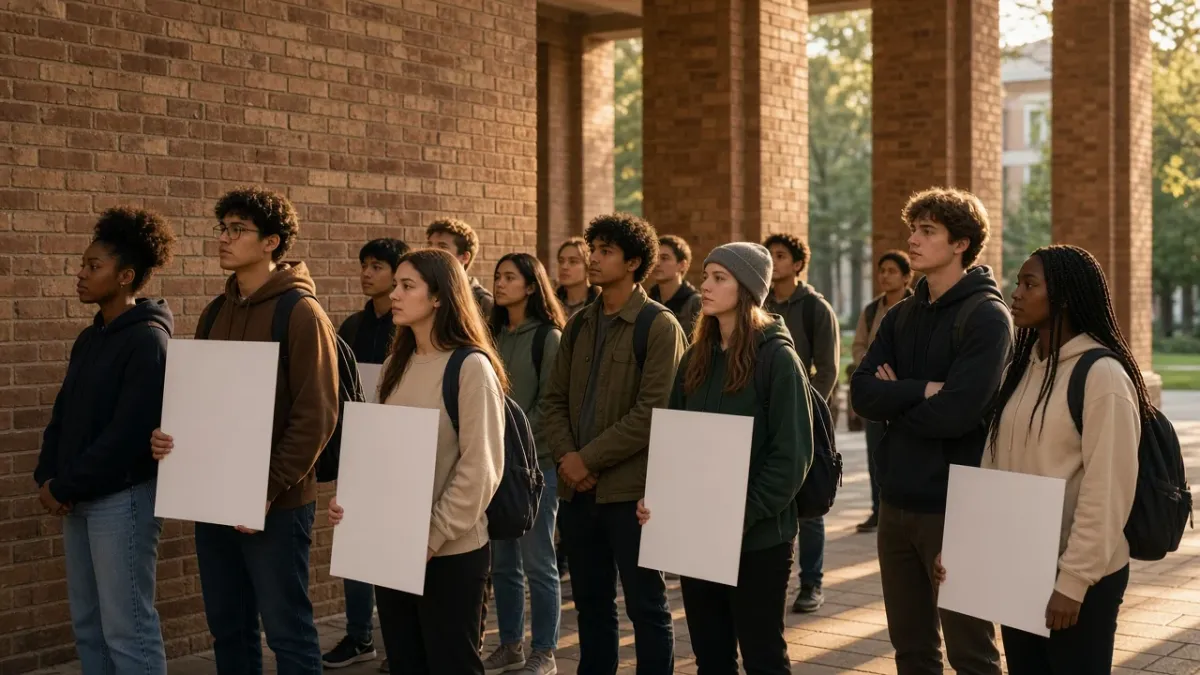
Maya C., a junior who asked to be identified by first name and last initial, organizes a group called Take It Back Indy with students Elijah and Zariya. The Campus Citizen says the group wants IU Indianapolis to restore the Multicultural Center and the LGBTQ+ Center. Both centers had operated in Taylor Hall under the campus Division of Diversity, Equity and Inclusion until IU closed its DEI office in May 2025, a timing the paper attributes to Mirror Indy. The 4:30 p.m. rally drew more than 30 people and ended with a march around campus. A caption on the page says more than 30 people crossed a street during that march.
Maya had worked at the Multicultural Center for about a year when an email arrived saying the center was closing. She used that story to open the rally, then stopped and told the crowd, “Yeah, I get emotional ‘cause it really was beautiful.” She said the center gave her the feeling that she belonged on campus, and that it was the first time she felt secure in her decision to come to IU Indianapolis. That is a support claim, not a branding claim. She is describing a room that changed whether the campus felt like a place she could stay.
The paper’s account of the afternoon is a call for two named rooms, not a general complaint about campus climate. The sign Maya carried during the march, as the caption prints it, read “Take back the multicultural and LGBTQ+ centers.” The ask is specific. A reader can disagree with the ask. A reader cannot honestly shrink it into a request for a slogan, a newsletter, or a tab on a student-life page. The students at the breezeway were asking for the centers.
What students said the rooms were for
In an interview after the rally, Maya described the ordinary uses that disappeared with the door. A student who was not a regular might heat up food, take a nap, or pick up a book from the library inside. Then summer ended, the student came back, and the room was gone. Her line, as the paper prints it, is “Just no explanation, nothing.”
She also said members of the Black Student Union told her they had about a week to move their belongings out. Some groups, she said, stored things in members’ cars and garages. That detail matters for any campus that treats a center as a closet with a logo. Belongings in a car are not a program. They are evidence that the organizations housed in the room had a physical life: banners, files, food, books, the objects a group needs before a meeting can start.
The paper, citing its own September 2025 reporting, says the Multicultural Center’s sign came down on Aug. 5, 2025. The Office of Health and Wellness Promotion and the Multimedia Production Center moved into the centers’ former space in Taylor Hall. The Queer Student Union, which had been based in the LGBTQ+ Center, moved to the Cube. An email the paper dates to Dec. 16, 2025, and attributes to Mirror Indy, said the organizations housed in the Multicultural Center had moved to the Office of Student Involvement without money for large events. The campus then canceled its Martin Luther King Jr. dinner, held since 1969. An IU spokesperson told Mirror Indy, in the paper’s account, that the campus was “moving away from dinners overall.” Students held an “eat-in” protest in January. The sentence does not print the year of that January protest.
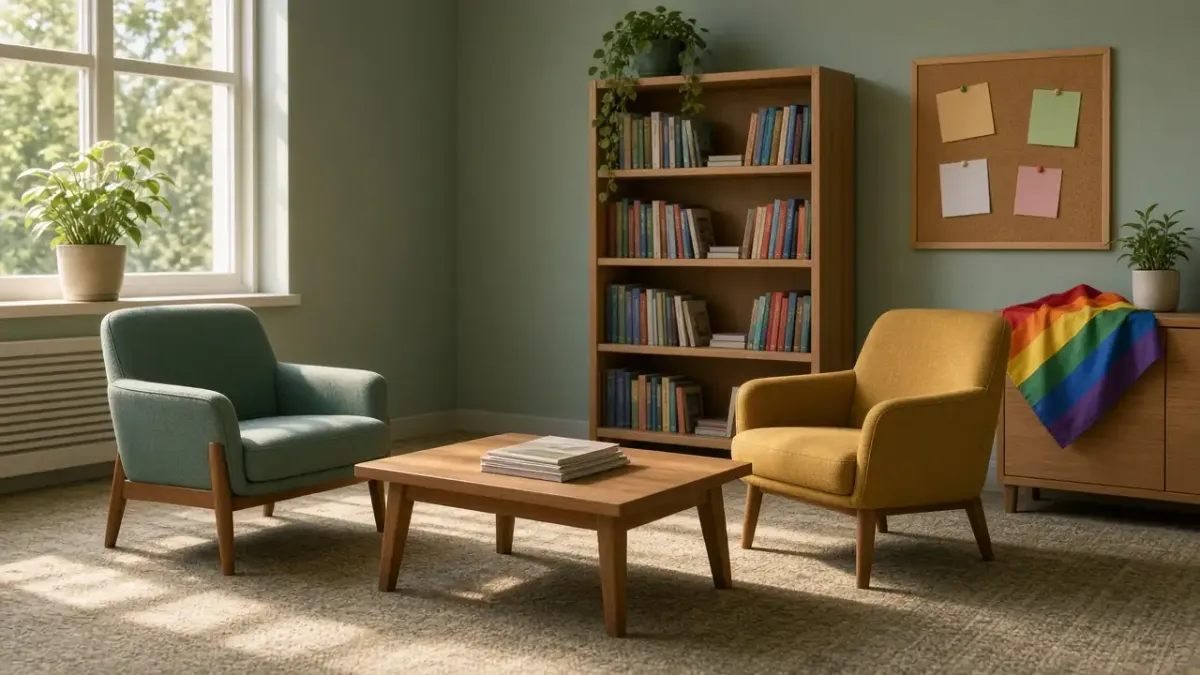
A support center is not only a meeting slot. The former website of the Multicultural Center, as the Campus Citizen describes it, listed a cultural lounge, a student organization suite, two conference rooms, a nursing mother’s room, an interfaith prayer room, and two all-gender bathrooms, along with the student organizations housed there. The paper says the center was completed on the first floor of Taylor Hall in 2009, and it attributes that completion date to the Wikipedia entry for Taylor Hall. A separate LGBTQ+ Center was already being planned by students and staff working with the Multicultural Center in fall 2015, according to a history the LGBTQ+ Center published. That center later operated in Taylor Hall’s UC 101A.
Those room types are the practical content of the name. A cultural lounge is not the same object as a conference room. A nursing mother’s room and an interfaith prayer room are not the same object as a general lobby. All-gender bathrooms are a design choice a trans or non-binary student can look for before choosing where to spend an hour between classes. When a paper lists them as features of a former website, a reader can treat the list as a map of what the room used to offer, not as a promise that every item is still in the building under a new sign.
The Cube is a different kind of room
Maya said administrators pointed students to the Cube, the student organization center on Level 3 of the Campus Center, as a replacement. Her distinction is the most useful sentence in the article for a student at another school. “It is a third space, but it’s not multicultural space,” she said. She compared the suggestion to telling someone the library is still available, so they can hang out there, when everyone already hangs out there.
A shared student-organization floor can be a real resource. Groups need mailboxes, a copier, and a place to book a table. The Campus Citizen does not say the Cube is closed, useless, or hostile. It reports Maya’s claim that a general floor is not the same thing as a multicultural room, and it reports that the Queer Student Union moved there after the LGBTQ+ Center closed. A student who needs a registered-organization mailbox may still find one on Level 3. A student who needed the named LGBTQ+ room, the cultural lounge, or the quieter list of rooms on the old website is being offered a different product.
Maya added a point that campus housing policy often skips. Many students can go home to a private space at the end of the day. “Some people can’t. This is their only space, and now it’s gone.” That sentence is about the center as a daily room, not as a parade stop. Commuter students, students who are not safe at home, and students who use the campus as their only quiet place between work and class are the people a “hang out in the library” answer fails first. The paper does not count how many students fit that description. It prints the claim from a student who worked in the room.
A freshman who looked before she enrolled
Jyla Robinson, a freshman biology major who plans to switch to public health, heard about the rally at a movie night in North Hall, where Maya announced it. She designed the flyers the day of the event, in three versions: one for the LGBTQ+ Center, one for the Multicultural Center, and one for both. One shows a globe and the words “take it back.” Another reads, in part, “We are still here. You cannot remove our diversity.” A caption says she held a flyer that reads, in part, “We are still here.”
Robinson said she is part of the community and that she is multicultural. She looked for LGBTQ+ organizations before enrolling and was disappointed to find the center gone when she arrived. “This is a public campus. This is for everybody,” she said. “We pay to come here. I paid $30,000 to come here.” Asked about administrators who say cuts protect state funding, she said the center “should not be the first thing cut,” and “I feel like they wasn’t fighting hard enough for it.”
The $30,000 figure is hers. The article does not print a bursar table, a residency status, or a financial-aid package next to it. A reader should not treat her sentence as the price of IU Indianapolis. The sentence still does a job. She is tying a public-campus claim to a bill she says she paid, and she is saying a center should not be the first cut if the stated reason for cuts is protecting state funding. The paper does not quote an administrator at the rally answering that point. It records the question she was asked and the answer she gave.
Her enrollment story is the other half of Maya’s belonging story. Maya found the center and then felt she could stay. Robinson looked for LGBTQ+ organizations before she arrived and found the center already gone. A support office that exists in a viewbook and not in the building is a different failure from a support office that never existed. The first one changes a decision a student already made. The article does not say Robinson would have chosen another campus. It says she looked, and she was disappointed.
The history the paper puts under the rally
The Campus Citizen does not treat the centers as a recent add-on. It traces the Multicultural Center to a student document. In November 2006, IUPUI’s Black Student Union wrote “Through Our Eyes: The State of the Black Student at IUPUI.” Maya said the union brought that document to administrators. The paper says the document charged that campus officials did not communicate effectively with Black students, calculated that Black student organizations produced 81% of student programming at IUPUI, and asked for a Black student center “to house an area for African American culture.”
In 2007, a Multicultural Center Concept Development Committee and then an implementation committee planned the space, according to “The Ground On Which We Stand,” a later proposal from the Black Student Union and other student groups. Those groups wrote that the request for a “black cultural center has been ignored for the more inclusive model of a multicultural center.” Maya told the crowd the center opened “a few years later.” The 2009 completion date, again, is the date the paper attributes to Wikipedia, not a date the rally invented.
That sequence is a support history, and it is also a record of a disagreement. Students asked for a Black cultural center. What opened was a multicultural center. The paper prints that disagreement rather than smoothing it. A reader who wants a single origin myth will not find one. A reader who wants to know why a 2026 rally talked about a 2006 document will find the chain: a student report, a committee, a room in Taylor Hall, and a later LGBTQ+ Center in UC 101A that students and staff were already planning by fall 2015.
At the rally, Maya showed archival photos of 2006 student protesters standing outside Taylor Hall and said some of them still work at the university. “I feel like we owe it to them,” she said. IUPUI later named its Through Their Eyes scholarship after the 2006 initiative. The paper, citing WRTV, says the scholarship gives $15,000 to a student whose family was displaced when the campus was built. That figure is a scholarship amount in the article’s account of WRTV’s reporting. It is not a budget for reopening the centers. The article does not print a reopening budget at all.
What organizers said they wanted next
Maya said the idea for Take It Back Indy began when Zariya suggested a documentary on the center’s history. The group spent about eight months preparing. It first called itself Bring It Back. Organizers changed the name, Maya said, because funding, support, and student voice were taken along with the centers, and they added “Indy” because another account already used Take It Back. “Protest is just protest, if it’s just protest,” she said. “You need to actually have action on the back end.”
She described the Sept. 30 rally as a call-out meeting. As of the Oct. 1 article, the group planned to hold meetings in the next two to three weeks to hear from students. Those weeks, counted from the article’s date, are not a calendar a reader can still join in late November. The article does not print a later update. What it does print, and what still travels, is the list of people the organizers hoped to work with: presidents of groups including the Black Student Union, the Latino Student Association, and the Queer Student Union. They were using “Through Our Eyes” as a guide.
Maya’s stated wants, in her words on the page, were transparency, more communication, and more student involvement in the processes. She also said a restored center might look different from the old one. “We could get multicultural space back, and it might not look like what it did before, but maybe we can make it better.” That sentence keeps the rally from being a demand to freeze 2009 in place. The room list on the old website is a record of what existed. It is not, in her own account, a blueprint that cannot change.
Elijah, who met Maya through the Sam Masarachia scholarship program, told the crowd he had written a speech but “barely rehearsed it.” He said the center was a place where everyone was welcome, and that places like that were getting rarer. He tied the closure to IU’s Expressive Activity Policy, which he said the university passed by pointing to the 2024 pro-Palestinian encampments in Bloomington and Indianapolis. “It takes away rights that we, as students of this campus, are owed,” he said. “They just keep taking things from us and expect us to do nothing about it.” He said he had taken part in the Indianapolis encampment and traveled to the one in Bloomington. He said he had no idea what to do next, that organizers had been planning next steps, and that they needed help from the students in the crowd. He said the same fight applies to majors IU has cut, and that the goal of the losses was “to keep us separated and disorganized and stressed out.” He closed with “let’s take it back.”
A student reading Elijah for a support plan should separate two things the paper places in one speech. One is the centers. The other is a wider claim about policy, cut majors, and the purpose of those losses. The article reports his claims. It does not independently test the purpose he assigns to the administration. The practical line he offers the crowd is the one about next steps: he did not pretend the march was the whole plan, and he asked the people in the breezeway for help.
The policy record the article sets beside the breezeway
The Campus Citizen places a longer policy record next to the rally. A reader can use it as context the paper assembled. A reader should not treat it as a current handbook.
The paper says IU closed its system-wide DEI office on May 22, 2025, and that a news release said the university wanted to “further ensure compliance” with state and federal guidelines, a point it attributes to Mirror Indy. It says that a month earlier, Indiana lawmakers had passed a law barring public colleges from taking actions based on characteristics such as race or gender, and that the Trump administration was pressuring colleges to end DEI programs. Those sentences are the paper’s frame for why a division that housed the centers closed. They are not a quote from an administrator at the Sept. 30 rally.
On the expressive-activity side, the paper says that on April 24, 2024, IU changed its Dunn Meadow policy the night before a planned pro-Palestinian encampment, and that police arrested 57 protesters at the Bloomington encampment on April 25 and 27, according to the Indiana Daily Student. At IU Indianapolis, students set up an encampment they called the “Liberated Zone” on April 26, 2024, in the same breezeway where the 2026 rally began. More than 30 students were protesting there in mid-May, and police had made no arrests, according to Mirror Indy as the paper cites it. Students planned to take that encampment down after trustees approved the Expressive Activity Policy, again according to Mirror Indy as cited.
The breezeway is also one of two sites of Democracy Plaza, chalkboard walls that a group of students, faculty, and staff started in summer 2004 for discussion of political and social issues, according to a 2010 American Democracy Project post the paper cites. In August 2024, IU said a task force would “reimagine” Democracy Plaza during the 2024-25 school year, according to the Division of Student Affairs as the paper cites it. Trustees passed the Expressive Activity Policy on July 29, 2024. The paper, citing Indiana Public Media, says the policy banned camping and barred expressive activity within 25 feet of building entrances. When it took effect on Aug. 1, 2024, it limited expressive activity to 6 a.m. to 11 p.m. In January 2026, federal Judge Richard Young ruled that version of the policy violated the First Amendment and ordered IU to expunge discipline records issued under it, according to Duke Law’s campus speech tracker as the paper cites it.
That January order is the newest legal date in the article. The article does not say whether the 6 a.m. to 11 p.m. limit, the 25-foot rule, or the camping ban remained the campus rule after the order. A student who needs the current expressive-activity rule has to read the current policy, not this October story. The story’s useful point is narrower: the rally returned to a breezeway the paper also identifies as a 2024 protest site and as a Democracy Plaza site, and Elijah treated the policy and the center closures as one pattern. The paper reports that treatment. It does not print a university statement that accepts or rejects it.
Maya also pointed to the Board of Trustees. The paper, citing the Indiana Capital Chronicle, says a provision in the 2025 state budget gave the governor the power to appoint all nine trustees and ended alumni elections for three seats. It says Gov. Mike Braun removed the three alumni-elected trustees on June 2, 2025, citing The Bloomingtonian. It says the board has one student member, whom the governor picks with help from a student-led committee, citing Axios. Maya cited FIRE’s free speech rankings. The paper says FIRE’s 2026 rankings, released in September 2025, placed IU 255th of 257 schools, and that the 2027 rankings, released Sept. 9, placed IU Bloomington 256th of 261, a placement it attributes to The Indiana Citizen. The sentence does not print a year beside “Sept. 9.”
None of those figures is a measurement of the Taylor Hall rooms. They are the rankings and governance facts Maya and the paper set beside the rally. A student who wants to argue about trustee selection can start from the citations the paper names. A student who wants to know whether the LGBTQ+ Center is open cannot get that answer from a rank of 255 or 256.
The same week, other campus accounts posted about remembrance
The Campus Citizen post is not the only campus account that treated LGBTQ space as news between 18 and 23 November 2026. Three other posts, fetched as posts and not as full articles, sit in that stretch.
On 18 November 2026 at 10:30 UTC, The Daily Orange posted that Syracuse University’s Hendricks Chapel and LGBTQ+ Resource Center hosted a Transgender Day of Remembrance service on Tuesday. The post opens with the line “They own a resilience that is truly a superpower.” It says the service honored victims of “intolerance and violence” against the transgender community. The post links to a Daily Orange story. The sentences here are the post. They are not a summary of the story behind the link.
On 19 November 2026 at 21:03 UTC, The Rider News posted that the 10th installment of Out on Campus is about Transgender Day of Remembrance, which the post calls an important celebration and memorial for the transgender community. The post credits Cal Sutton as the writer and Grace Juarez as the artist. It links to a Rider News page. This account uses the post text, not the page.
On 18 November 2026 at 00:00 UTC, Campus Reform posted that California State University, Los Angeles is hosting a series of diversity-focused events in November, including a “Trans Week of Remembrance and Celebration,” as the university faces budget cuts and declining enrollment. The post does not give a dollar figure, a headcount, or a room number.
Those three posts do not mention IU Indianapolis, Taylor Hall, or Take It Back Indy. They do show a week in which campus accounts were still writing about transgender remembrance and, in one case, about events continuing while a university faces cuts. The Indianapolis story is the one with a full reported page in hand. Its subject is a room that closed, not a service that was held. A student can hold both facts without forcing them into one plot. A chapel service and a resource center can still host a remembrance while, on another campus, students are asking for a center back. The posts do not say those campuses copied each other.
What a student elsewhere can actually use
The original value of this record is not a script for a march. The Campus Citizen does not print a permit process, a chant sheet, or a budget proposal. What it prints is a distinction a student can carry to a different campus, and a short list of questions that do not depend on IU’s trustees.
The distinction is Maya’s. A third space where every organization has a slot is not the same object as a multicultural room or an LGBTQ+ room with a name, a door, and a list of uses. Heating food, napping, picking up a book, storing a group’s belongings, and finding a bathroom that matches the way you move through the day are uses. A mailbox on Level 3 may still be worth having. It does not answer the freshman who looked for LGBTQ+ organizations before she enrolled and found the center gone.
The questions that travel are the ones Maya named as the current want: transparency, communication, and a way for students to be involved in the process. A student at another school can ask which office now holds the groups that used to sit in a named center, whether those groups still have money for the events they used to host, and whether the replacement room is a cultural room or a general floor. The article’s Dec. 16, 2025 email, as the paper reports it through Mirror Indy, is an example of the second question already having an answer on this campus: organizations moved to the Office of Student Involvement without money for large events. Another campus will have a different memo. The question is still the right shape.
Robinson’s flyer line, “We are still here. You cannot remove our diversity,” is a claim about people, not about furniture. The rally’s sign was a claim about furniture and programs. Both can be true, and they ask for different follow-up. A campus can keep students and still close the room those students used. The paper’s reporting is about that gap. Presence in a student body is not a lounge, a prayer room, or UC 101A.
Maya’s own path, as the paper tells it, is a first-generation path. A 21st Century Scholars award fell through during her senior year at Pike High School. She then won about eight scholarships through Pike and, at the end of her freshman year, the Sam Masarachia scholarship. She said she put a great deal of work into four years, that the two centers were a big part of those years, and that it felt as if she cared more than the administration did. “We’re gonna bring it back,” she said. That closing line is a promise from an organizer, dated to the rally. It is not a report that the centers reopened.
What these texts do not settle
The Nov. 23 post does not say why the account shared an Oct. 1 article on that day. It does not say the centers were restored between the rally and the post. It does not name an administrator. The article does not name an administrator speaking at the rally either. It does not print a restoration date, a reopening budget, or a current floor plan of Taylor Hall. It does not say whether the Office of Health and Wellness Promotion and the Multimedia Production Center were still in the old space on Sept. 30, 2026. It says they had moved into that space after the sign came down on Aug. 5, 2025.
The article does not say the January 2026 court order reopened a center. It says Judge Richard Young ruled that a version of the expressive-activity policy violated the First Amendment and ordered discipline records under it expunged, according to a campus speech tracker. A legal win on a speech rule is not a key to UC 101A. Confusing those two outcomes would send a student to the wrong office.
The rankings, the trustee statute, and the $15,000 scholarship are in the article because Maya or the paper placed them near the story. They do not measure whether a queer student can find a room this week. The $30,000 figure measures one student’s stated cost, not the university’s price list.
A student who needs the live status of the Multicultural Center or the LGBTQ+ Center has to check the campus, not this page and not the Nov. 23 post. What those two texts do provide is a reported account of what students said they lost, what they were offered instead, who organized the ask, and which questions they wanted answered: communication, transparency, and a seat in the process. That is a support record. It is not a restored door.